Can a Short Accelerated Weathering Study Predict Years of Service?
Your product must survive years outdoors, but you can't wait that long to test it. Accelerated weathering seems like a perfect shortcut, but can you trust the results?
No, a short accelerated weathering study alone cannot reliably predict years of service. Prediction is only possible when the lab test results show a strong, consistent correlation with data from real-world, outdoor exposure over a meaningful period for that specific material and environment.
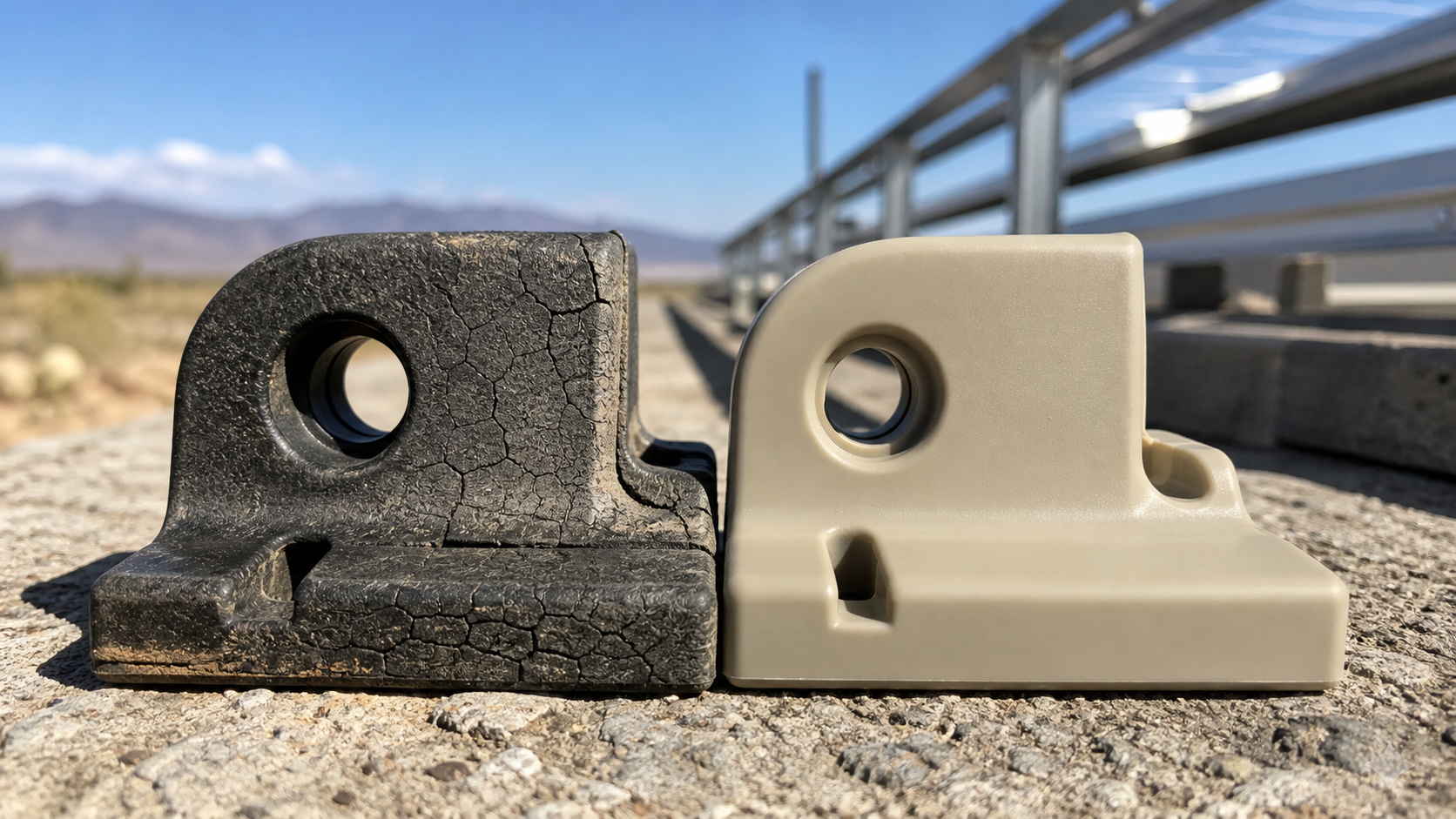
I've seen many project teams rely on a simple data sheet value from a 1,000-hour test to claim a 10-year outdoor lifespan. It’s an appealing shortcut, but it’s a gamble. The forces at play in a test chamber are not a perfect copy of a sunny field or a humid coastline. We need to look much deeper than a single test report to understand what might really happen to a material over its lifetime. To make a confident prediction, we have to question the test itself.
Reviewing the Acceleration Assumptions Behind the Study?
We assume lab tests simply fast-forward time. But what if the intense lab environment creates failures that would never happen in the real world? We must check these assumptions first.
We review acceleration assumptions by questioning if the lab's intense UV light, constant high heat, and heavy moisture cycles truly mimic real-world conditions. The goal is to confirm the test is a valid representation of natural weathering, not an artificial environment that causes unrealistic failures.
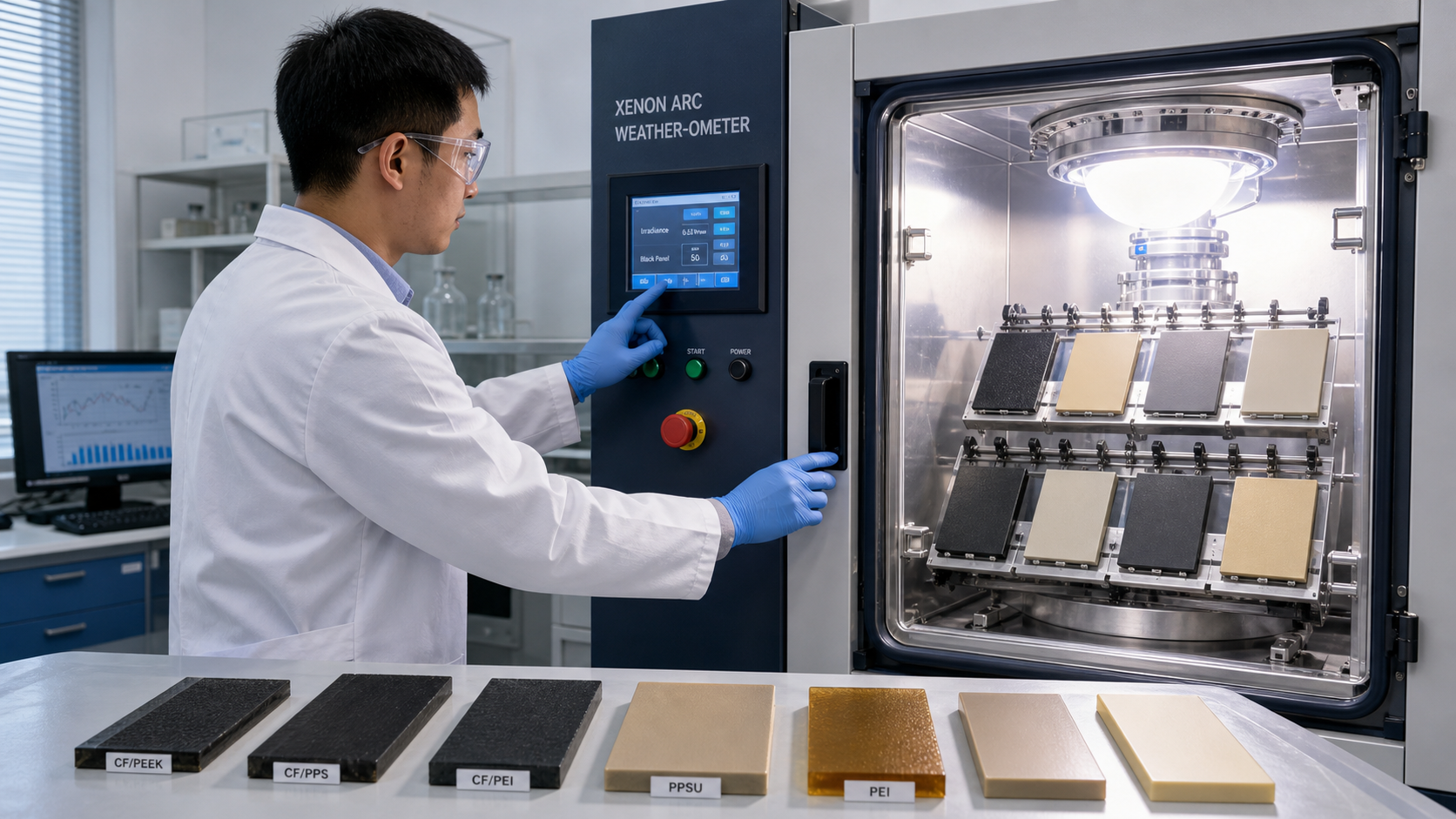
The core idea of accelerated weathering is to concentrate the damaging elements of weather into a shorter time. This sounds simple, but the "how" is critical. We are making big assumptions about how materials will react.
The Reciprocity Assumption
The first major assumption is reciprocity. It suggests that a high dose of UV radiation for a short time equals a low dose over a long time. But many polymer degradation mechanisms don't work this way. A sudden, intense blast of UV and heat can trigger chemical reactions that would not happen under milder, real-world conditions. It's like trying to bake a cake by turning the oven to its highest temperature for five minutes instead of the recommended 30 minutes at a lower temperature. The result is a burnt outside and a raw inside, not a perfectly baked cake, just faster. The process matters just as much as the total energy input.
Environmental Factor Assumptions
We also assume we've picked the right damaging factors. Most chambers focus on UV light, temperature, and water. But what about acid rain, airborne pollutants, salt spray, or freeze-thaw cycles? These factors can work together to break down a material in ways a simplified lab test will never see. We must ask if our test chamber is testing for the right things.
| Assumption | Potential Reality |
|---|---|
| Higher UV intensity equals faster aging. | Excessive UV intensity can cause unrealistic surface hardening or embrittlement. |
| Constant high temperature accelerates reactions. | Real-world temperature cycles (hot days, cool nights) cause stress from expansion and contraction that a constant temperature test misses. |
| Continuous water spray mimics rain/humidity. | Natural wet/dry cycles can be more damaging, as they concentrate corrosive elements on the material’s surface as water evaporates. |
Comparing Laboratory Exposure With Field Conditions?
Your lab data looks perfect. But when the component fails after two years in the field, that data is worthless. We must bridge the gap between the lab and the real world.
We compare lab and field conditions by placing identical material samples in both environments at the same time. We then track the same key properties, like strength or color change, to see if the lab degradation pattern matches the real-world degradation pattern.
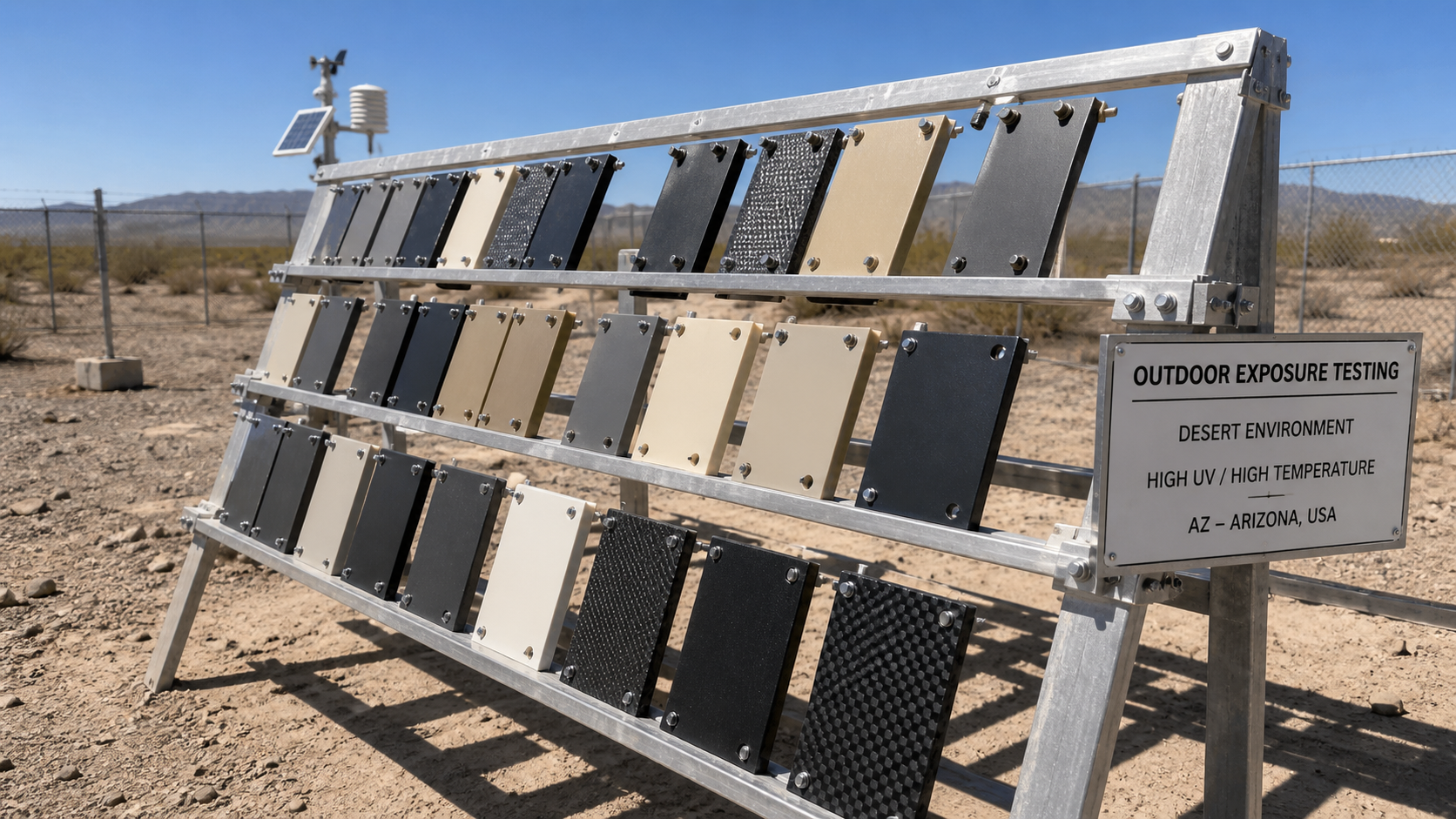
A laboratory weathering chamber is a clean, predictable environment. The real world is not. To build confidence in a lab test, we must run it in parallel with an outdoor exposure test. We take samples of the same material, often from the same production batch, and put some in the test chamber and others on outdoor racks in relevant locations. Standard locations like Arizona provide high UV and heat, while Florida offers high UV with extreme humidity and salt air.
Over months and years, we periodically take samples from both the lab and the field and measure their properties. We might look at tensile strength, impact resistance, color change (Delta E), or surface gloss. The goal is to see if the material is degrading in the same way in both environments. For example, if a carbon fiber-reinforced PEEK (CF/PEEK) composite loses its gloss in the lab but loses its strength in the field due to moisture attacking the fiber-matrix bond, then the lab test is not a good predictor. The failure mechanism must be the same. This direct comparison is the only way to validate that the accelerated test is truly simulating reality for a specific material like CF/PPS or CF/PEI.
Looking for Correlation Over Relevant Durations?
You have lab data and some early field data. But if they don't line up, you cannot make a reliable prediction. Finding a strong, consistent correlation is the essential step.
We look for correlation by plotting the degradation of a property from the lab against the degradation of the same property from the field. A strong, linear relationship over time suggests the lab test is a useful predictor. Without this correlation, any service life estimate is a guess.
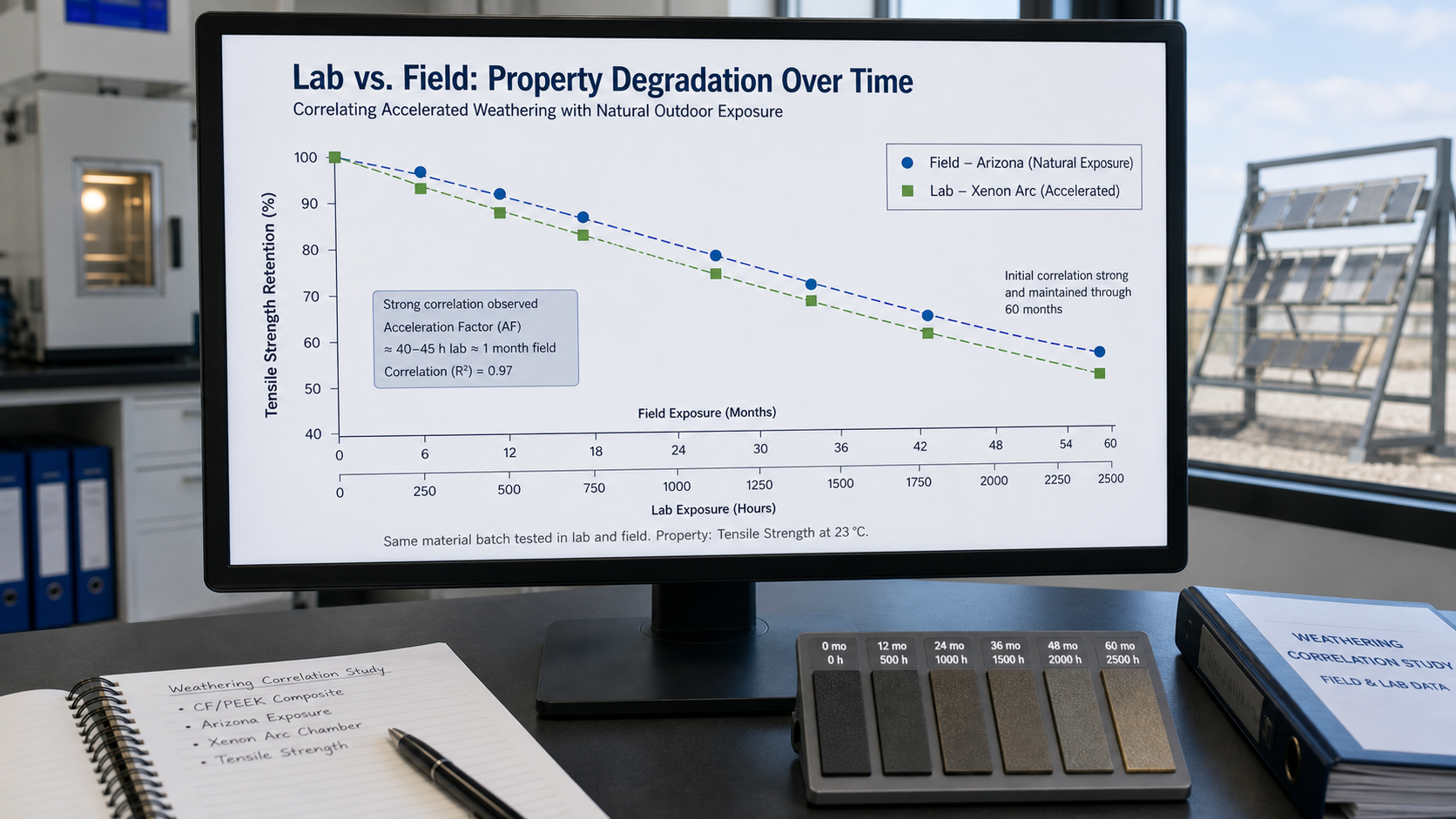
Once we have data from both the lab and the field, we can look for a mathematical relationship. If 500 hours in the lab causes the same amount of color fade as one year in Arizona, and 1,000 hours in the lab equals two years in Arizona, we are building a correlation. We can plot these points on a graph. A straight line is the gold standard—it suggests a consistent acceleration factor. This means we might be able to use the lab test to predict what will happen in year three, four, or five.
However, this correlation must hold over a "relevant duration." A good correlation in the first six months might disappear later. A material might resist UV very well at first, but once the surface layer breaks down, degradation can accelerate rapidly. This is a common failure mode in some polymers. The correlation found in the early stages becomes useless. That's why we must continue field testing for as long as possible. A short-term correlation is not enough evidence to make a long-term claim. It's about proving that the lab and field results stay in lockstep over a period that is meaningful for the product's intended application.
Limiting Lifetime Claims Where Correlation Is Missing?
Marketing wants to claim a "20-year outdoor lifespan." But the test data is weak or only covers two years. Making an unsupported claim can lead to expensive failures and a loss of trust.
When a strong correlation between lab and field data is missing, we must limit our lifetime claims to what has been directly observed and proven in the field. We avoid extrapolating or guessing. This evidence-based approach protects our customers and our reputation.
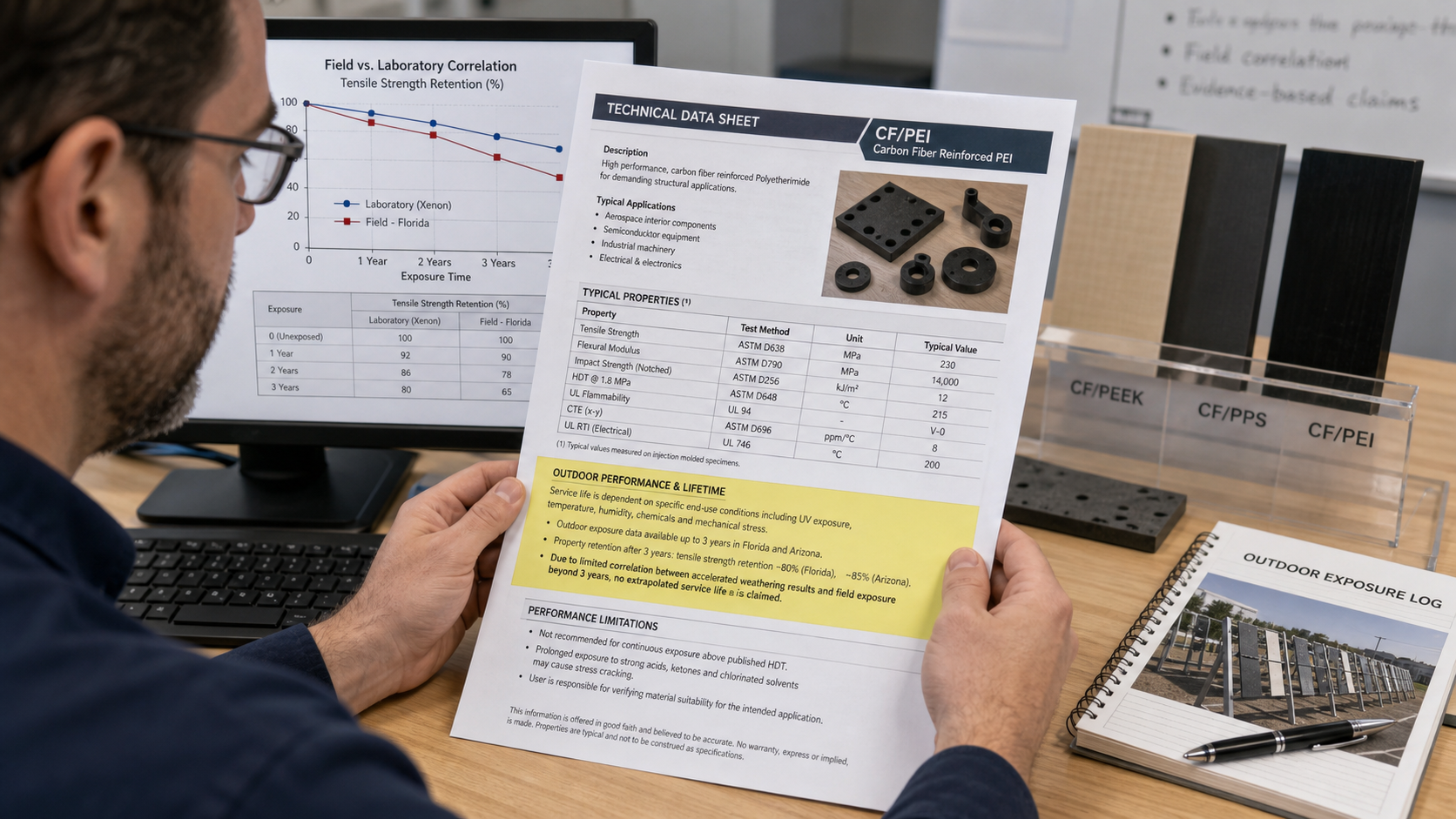
This is where engineering integrity comes first. If the data from our lab chamber and our Florida test rack don't line up for a material like carbon fiber-reinforced PEI (CF/PEI), we cannot use the lab data to predict its life in Florida. The test has failed to simulate reality. In this case, the only honest claim we can make is based on the real-world data we have. If the CF/PEI samples have survived for three years in Florida with acceptable property retention, we can state that. We cannot, however, use a 2,000-hour lab test to claim it will last for 15 years.
At our company, we recognize that different high-performance polymers like CF/PPS, CF/PEI, and CF/PEEK degrade through different mechanisms. A test protocol that works for one may not work for another. Therefore, we insist on using field correlation to make lifetime claims an evidence-based decision, not one based on a polymer's brand name. We also limit our findings to the specific materials and conditions studied. We do not treat a third-party study on one grade of PEEK as universal proof of performance for all PEEK materials, including our own products. This disciplined approach ensures we provide reliable information, not just optimistic marketing.
Conclusion
Accelerated tests are a valuable tool, not a crystal ball. Predicting service life requires careful, long-term correlation with real-world data to make responsible, evidence-based claims for a specific material.