Why Does a PEEK Nozzle Freeze During Insert Loading?
Your PEEK insert molding process runs perfectly, then suddenly stops. The press alarms out with a short shot. You find the nozzle is completely blocked. What went wrong?
A PEEK nozzle freezes during insert loading primarily because of heat loss. When the mold is open for an operator to place an insert, the hot nozzle tip loses critical heat to the cooler mold and the surrounding air. This extended, often inconsistent, delay allows the PEEK to solidify.
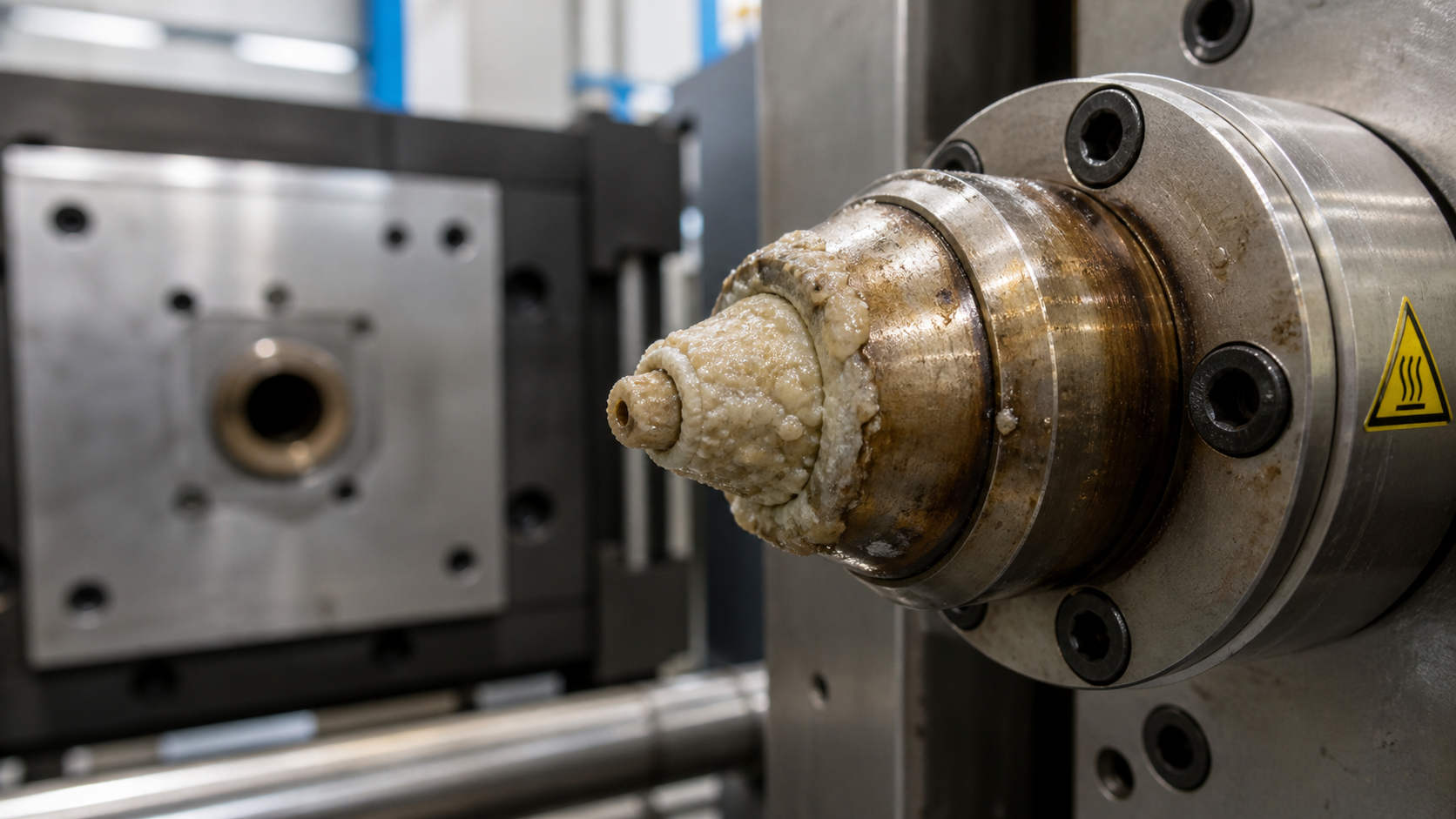
This issue is a frequent headache in high-performance polymer processing. We often treat PEEK like any other material, but its high melting point and rapid solidification demand a much stricter process window. The problem isn't just about the polymer; it's about the interaction between the material, the machine, and the operator. Let's break down where the heat is lost and how to control the process to prevent this from happening. We need to move from relying on the polymer's name to making evidence-based decisions about our cycle.
Where the Nozzle Loses Heat During Loading?
You have your nozzle temperature set correctly, but parts still fail. You might be tempted to crank up the heat, risking material degradation. The real solution starts with identifying the leaks.
The nozzle loses heat in two main ways during the loading sequence. First, through direct contact (conduction) with the much cooler sprue bushing of the mold. Second, it radiates heat into the open air (radiation and convection) while waiting for the cycle to resume.
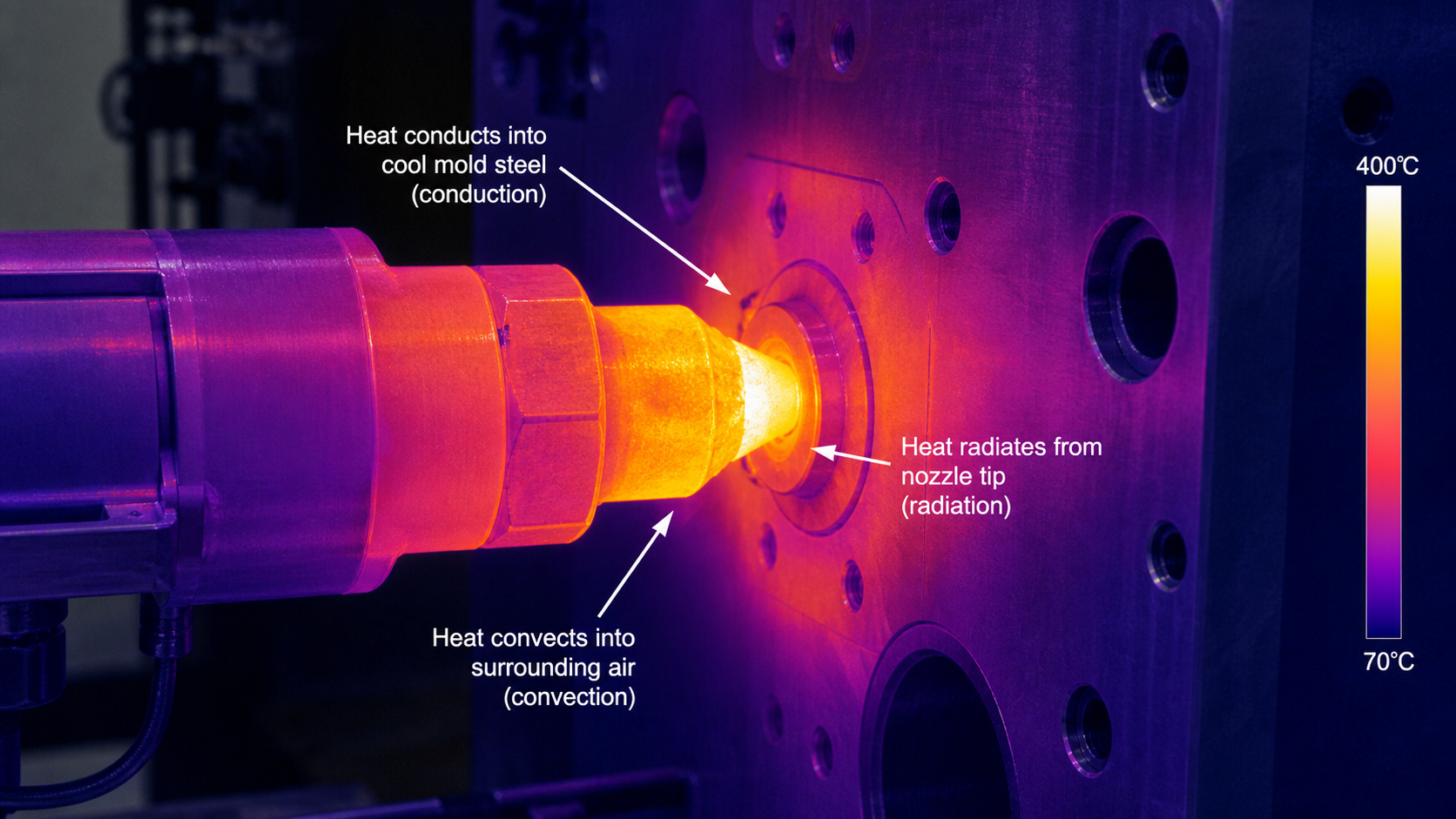
PEEK has a very high processing temperature, often around 380°C (716°F). Its freezing point is also high, so it doesn't take a large temperature drop to cause solidification at the very tip of the nozzle. When the mold opens, the nozzle either stays in contact with the sprue bushing or pulls back slightly. In both cases, a significant thermal battle begins. The mold, typically held at a much lower temperature (e.g., 180°C or 356°F), acts as a massive heat sink, constantly pulling energy away from the small nozzle tip. The longer the mold is open, the more heat is lost.
Key Heat Transfer Mechanisms
We can break down the heat loss into a few key areas. I’ve found it helpful to think about it in a structured way.
| Mechanism | Description | Impact on PEEK Freeze-Off |
|---|---|---|
| Conduction | Heat transfer through direct physical contact. | This is the fastest and most significant source of heat loss. The hot nozzle tip directly touches the cooler, massive steel mold. |
| Convection | Heat transfer through the movement of air. | Cool air currents in the factory can flow over the exposed nozzle tip, carrying heat away, especially during long open-mold times. |
| Radiation | Heat transfer through electromagnetic waves. | The hot nozzle radiates thermal energy into its cooler surroundings. This is a constant, steady drain of heat whenever the mold is open. |
Understanding these pathways is the first step. It's not one single cause, but a combination of all three chipping away at your nozzle's temperature stability. The key variable that magnifies their effect is time.
Measuring Delays Between Insert Placement and Injection?
Your process works fine for one operator but fails for another. This inconsistency leads to high scrap rates and endless frustration. The key is to stop guessing and start measuring.
You can measure the delay using the molding machine's internal cycle timer to log the "mold open" time. Track this time from the moment the mold fully opens until it begins to close after the insert is placed. This data reveals the variations causing the freeze-off.
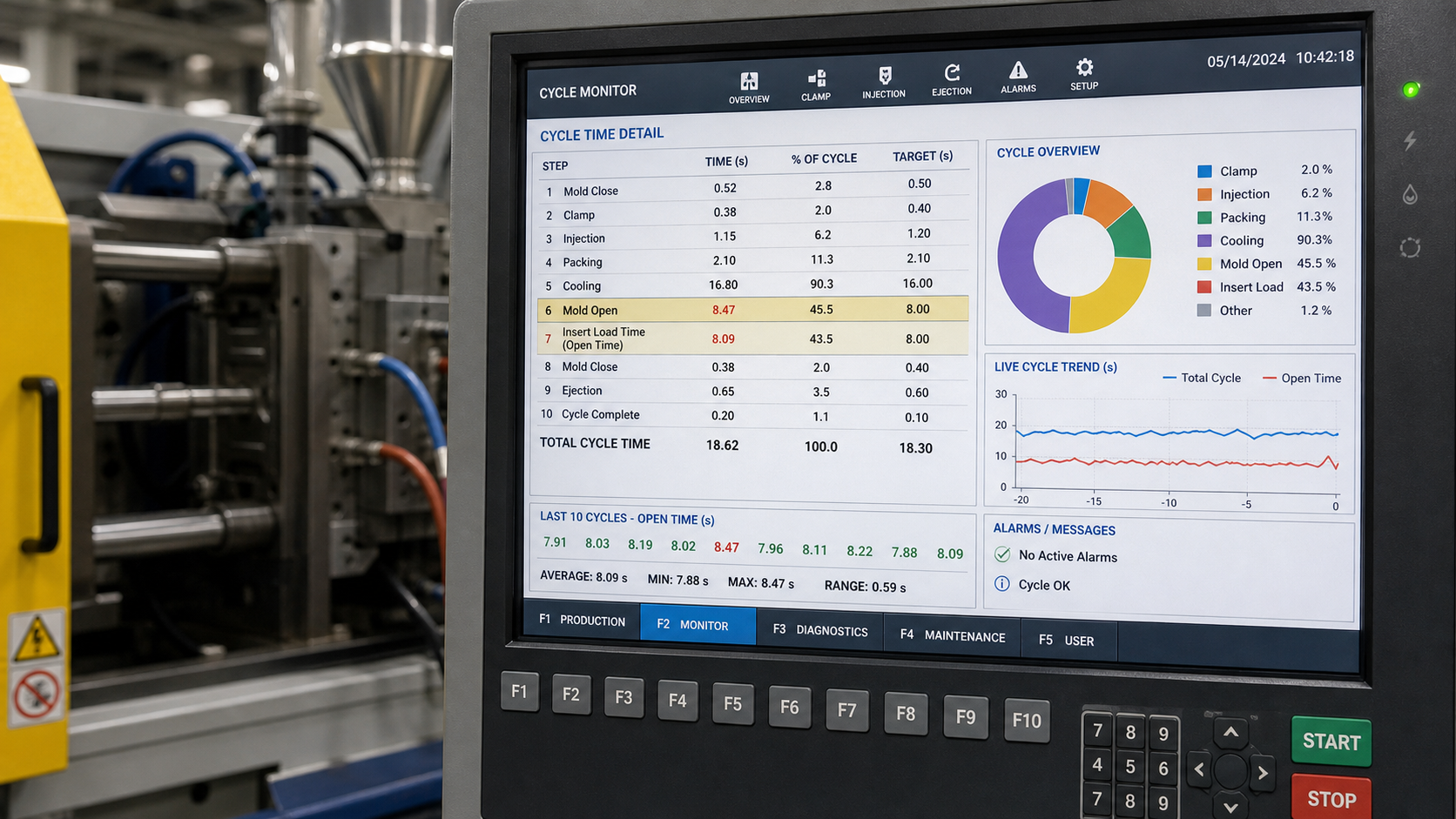
The human element is often the biggest variable in any manual or semi-automated process. One operator might be quick and decisive, placing the insert in 5 seconds. Another might be more cautious, taking 10 seconds, or get distracted and take 15. For many polymers, this variation is no big deal. For PEEK, it's a process killer. A 10-second difference is more than enough time for the nozzle tip to cool below PEEK's freezing point.
When I work with clients on this problem, the first thing I ask for is a simple time log. We stand by the machine with a stopwatch for an hour and write down the mold-open time for every single cycle. We note which operator is running the press. The results are almost always shocking. We see variations that directly correlate with failed parts. The goal is not to blame the operator, but to understand the reality of the process. Once you have the data, you can make an evidence-based decision. You can't fix a problem you haven't measured. This simple act of logging cycle times transforms the problem from a mystery into a solvable engineering challenge.
Distinguishing Freeze-Off From Restricted Melt Flow?
You get a short shot and your first instinct is to blame a frozen nozzle. But you could be chasing the wrong issue, leading to changes that don't help or even make things worse.
A true nozzle freeze-off is a complete blockage; injection pressure spikes but no material flows. Restricted flow, from contamination or degradation, often produces a partial part, streaks, or splay, and may show gradually increasing pressure over several cycles.
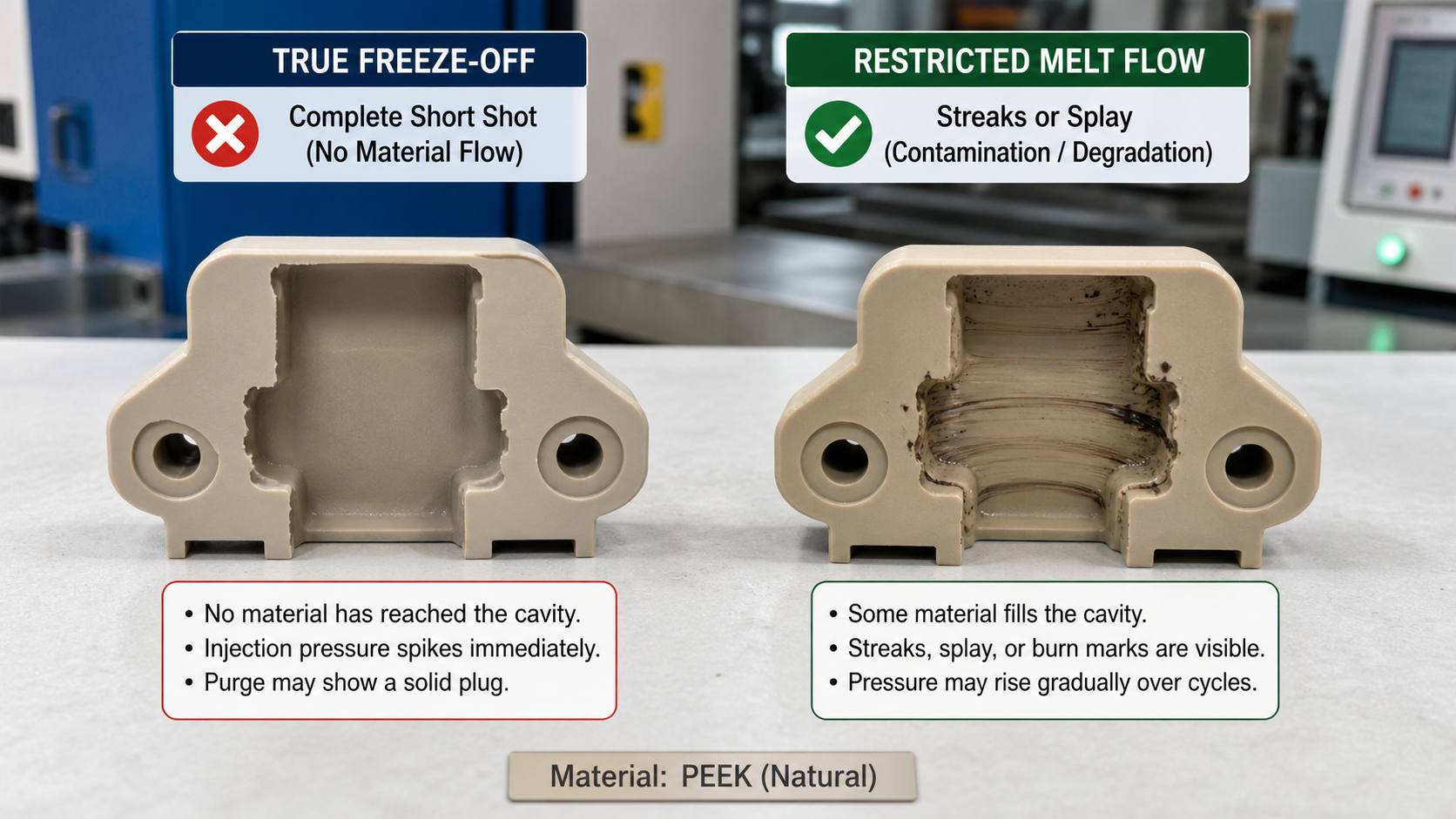
This is a critical distinction. If you assume a freeze-off and increase nozzle heat, you might actually be degrading contaminated material stuck in the nozzle, making the blockage worse. I always recommend a simple diagnostic step after a failure. Purge the nozzle. Does anything come out? If you get a clean, steady stream of PEEK, the blockage was likely temporary freeze-off. If the purge shot is discolored, contains black specks, or comes out with difficulty, you likely have a contamination or degradation issue.
Contamination is a common problem because PEEK is processed at temperatures that will burn almost any other polymer. Even a tiny amount of a material like polypropylene or ABS left in the barrel from a previous run will turn into carbon and clog the nozzle orifice. Extended residence time during interrupted insert-loading cycles also contributes. If the PEEK melt sits stagnant in the hot barrel for too long, it can begin to degrade, increasing its viscosity and restricting flow. This feels like a freeze-off but is actually a material problem.
Making the Loading Sequence Repeatable Across Operators?
You've measured the delays and confirmed that operator variation is the root cause. Now, how do you fix it? Simply telling everyone to "work faster" or "be more consistent" is not a solution.
Make the sequence repeatable by creating a standardized work instruction with clear steps and visual aids. Use a jig to pre-position inserts, and set a fixed mold-open time on the machine. This forces a consistent pace, removing operator judgment from the timing.
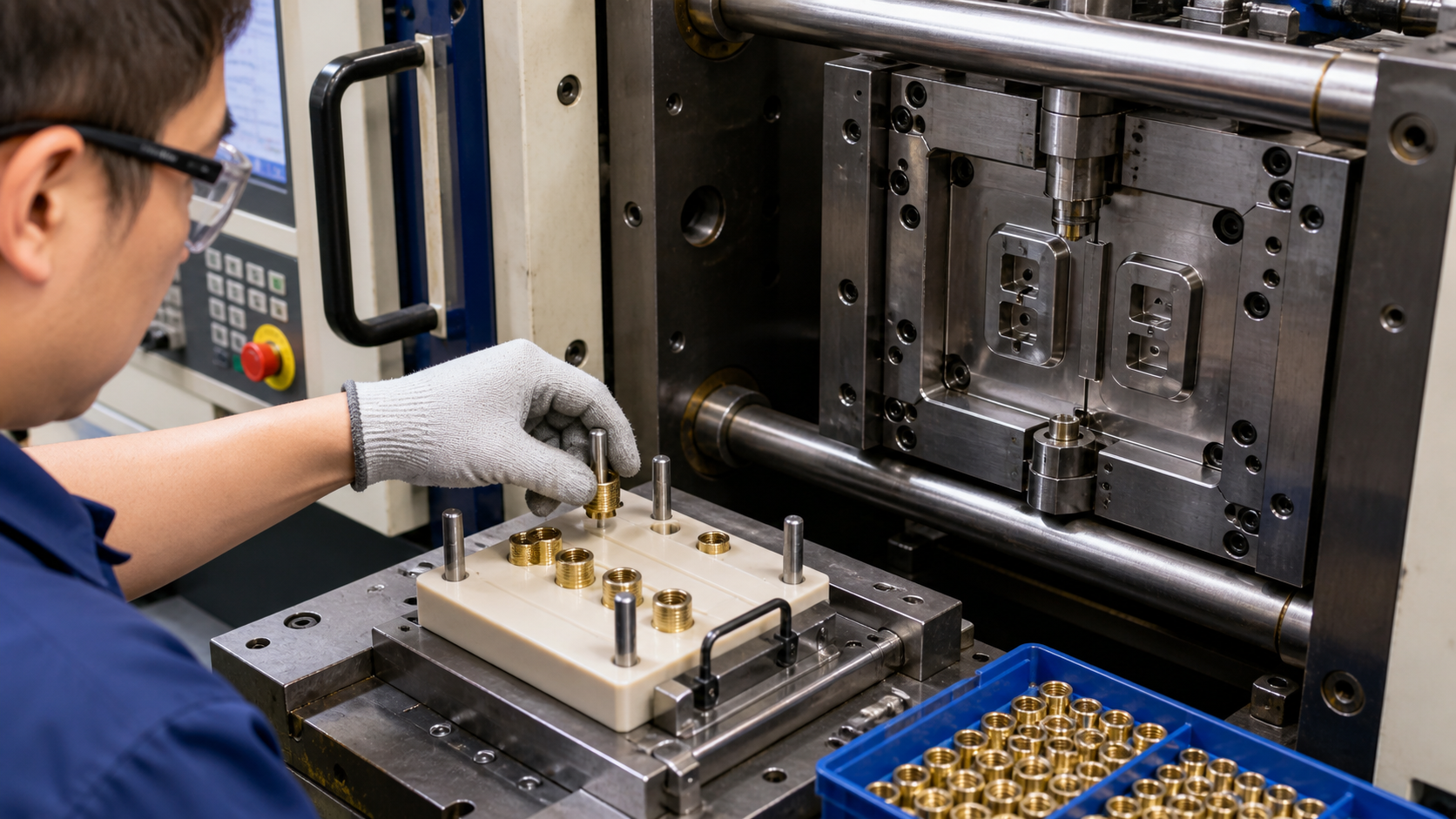
The goal is to engineer the variability out of the process. I’ve had great success with clients by implementing a few simple, low-cost changes. First, we create a clear standard operating procedure (SOP). This isn't a long document; it's a one-page sheet with pictures showing the exact steps for picking up and placing the insert. Second, we work on ergonomics. We place a tray with the inserts right next to the operator, all oriented in the correct direction. This eliminates fumbling and searching.
The most effective change is often to take the timing control away from the operator and give it back to the machine. Instead of letting the operator close the mold whenever they are ready, we program a fixed mold-open time into the cycle—say, 8 seconds. An audible beep or a light can signal when time is running out. This forces a consistent rhythm. The operator quickly adapts to this pace. It removes the guesswork and ensures the nozzle is never exposed for too long. It turns the process from an art into a science, which is exactly what high-performance materials like PEEK demand.
Conclusion
PEEK nozzle freeze-off is a solvable problem of heat and time. By measuring cycle delays, standardizing operator actions, and distinguishing blockages from contamination, you can create a robust and repeatable insert molding process.