Resin pellets should be selected from the service conditions, not the material name. A part that sees hot steam needs a different polymer from a part that sees dry heat and abrasive wear. A connector that needs low smoke may need a different grade from a pump part that needs chemical resistance.
This guide compares five engineering resin families: PEEK, PPS, PPSU, PEI, and PPA. It reviews five manufacturer technical references and turns their material descriptions into a selection framework. Use the comparison as a first screen. Confirm the final choice with the exact grade datasheet, mold design, processing window, and regulatory requirements.
Quick comparison
| Resin family | What the technical sources emphasize | Strong fit | Main check before ordering |
|---|---|---|---|
| PEEK | Continuous use around 250 to 260 °C for unfilled grades, chemical resistance, wear options, and sterilization choices [1] | High heat, chemical exposure, wear parts, medical and semiconductor components | Cost, crystallization, grade filler, and processing temperature |
| PPS | Chemical resistance, low water absorption, steam resistance, electrical insulation, and dimensional stability above 200 °C [2] | Chemical equipment, electrical parts, pump parts, and tight-tolerance components | Brittleness in the chosen grade and weld-line strength |
| PPSU | About 180 °C operating temperature, impact strength, hydrolysis resistance, and repeated steam sterilization [3] | Medical parts, fluid handling, and reusable equipment | Chemical compatibility and the sterilization cycle |
| PEI | About 170 °C continuous service, creep resistance, low smoke, flame retardancy, and dimensional stability [4] | Aerospace interiors, electrical connectors, medical parts, and housings | Color, stress cracking, and the required flame rating |
| PPA | Lower moisture uptake and higher heat resistance than nylon 66, with stiffness and sliding properties [5] | Automotive parts, connectors, housings, and metal replacement designs | Moisture conditioning, weld lines, and reinforcement level |
The table shows why a single ranking does not work. PEEK leads on temperature in the cited unfilled grade. PPSU leads when repeated steam exposure and impact strength drive the design. PPA can replace a metal or standard nylon part when the design needs more heat and less moisture sensitivity. The right answer depends on the failure mode you need to avoid.
1. PEEK: the heat and wear choice
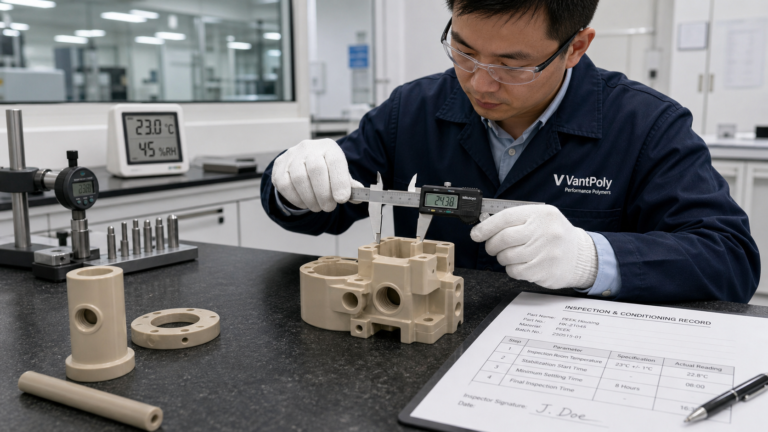
Ensinger describes PEEK as a semi-crystalline engineering thermoplastic with strong chemical resistance. Its unfilled TECAPEEK natural grade has a listed continuous service temperature of 250 to 260 °C, a short-term temperature of 300 °C, a glass transition point of 143 °C, and a melting point of 343 °C [1]. These figures apply to the cited grade. They do not apply to every PEEK compound.
PEEK also supports a wide filler strategy. Carbon fiber, glass fiber, PTFE, graphite, and other systems can change stiffness, friction, wear, and thermal expansion. That makes PEEK useful for seals, bearings, semiconductor parts, aerospace components, and medical devices. The filler can also change flow, shrinkage, surface finish, and electrical behavior.
Choose PEEK when temperature and chemical exposure leave little room for compromise. Check crystallization during molding. A slow or uneven cooling cycle can change shrinkage and part dimensions. Check the grade datasheet for melt temperature, mold temperature, fiber content, and post-processing requirements.
2. PPS: chemical resistance with dimensional control
The Ensinger PPS reference describes PPS as a semi-crystalline high-temperature polymer. It keeps chemical resistance and tensile strength at temperatures above 200 °C. It also has low water absorption, resistance to hot water and steam, and good dimensional stability [2]. The page lists a long-term heat resistance of 230 °C and a short-term value of 260 °C for its referenced material data.
PPS fits electrical insulation, pump components, chemical handling, and parts that need tight tolerances. Glass-fiber grades raise strength and stiffness, but they can increase anisotropic shrinkage. That difference matters when a mold has long flow paths or thin walls.
PPS can be a better fit than PEEK when the part needs chemical resistance and dimensional control at a lower material cost. Do not treat that as a universal cost rule. Resin price depends on grade, filler, color, certification, and supply volume. Before production, test weld lines and molded-in stress in the actual geometry.
3. PPSU: repeated steam cycles and impact strength
PPSU is an amorphous polysulfone. Ensinger lists a high glass transition temperature, low moisture absorption, good chemical compatibility, high impact strength, and hydrolysis resistance. The cited page lists an operating temperature of 180 °C and describes repeated superheated-steam sterilization as a suitable use case [3].
That profile makes PPSU useful for medical device parts, fluid-handling components, and reusable equipment. Its impact strength can help when a part must survive drops, assembly force, or repeated handling. Its amorphous structure also gives different shrinkage behavior from a semi-crystalline resin such as PEEK or PPS.
PPSU still needs a chemical review. A material that handles steam may react poorly to a cleaning agent, solvent, or disinfectant used in the same workflow. Define the full exposure sequence. Include temperature, concentration, contact time, pressure, and the number of cycles.
4. PEI: stiffness, flame behavior, and low smoke
Ensinger describes PEI as a polyetherimide with high continuous service temperature, creep resistance, hydrolysis resistance, and dimensional stability. Its technical page lists a continuous service temperature of 170 °C. It also notes inherent flame retardancy, low smoke emission, electrical insulation, and radiation resistance [4].
These properties support aerospace interior parts, electrical connectors, laboratory equipment, and medical components. PEI can suit designs that need a stiff amorphous resin with a flame rating. The source also compares PEI with PSU and reports a higher continuous operating temperature for PEI in the cited material comparison.
The design review should include stress cracking, especially near sharp corners, inserts, and molded-in stress. Confirm the required UL94 classification on the exact grade. Flame performance can change with color, wall thickness, filler, and test direction.
5. PPA: a bridge between nylon and higher-temperature resins
Ensinger describes PPA as a semi-crystalline aromatic polyamide. The page emphasizes high heat resistance, low moisture absorption, and sliding properties. It also states that PPA is stronger, stiffer, less moisture-sensitive, and more heat-resistant than nylon 66 in the cited comparison [5].
PPA often suits automotive components, electrical connectors, and housings. Designers also use it as a metal substitute when the part can gain from lower mass or integrated features. Glass-fiber and mineral-filled grades can improve stiffness, but they also change flow, surface appearance, weld-line behavior, and shrinkage.
PPA is not moisture-free. Conditioned properties can differ from dry-as-molded properties. Test the part after the moisture exposure expected in service. Use that result when you set tolerances, clamp loads, and electrical clearances.
How to choose between the five families
Start with the highest service temperature and the exposure that causes the most damage. Then screen the materials in this order:
- Set the temperature limit. Define continuous temperature, short peaks, heat-up rate, and cooling rate. Do not select a resin from a short-term number alone.
- List every chemical. Include process fluids, cleaners, lubricants, adhesives, and sterilants. Test the finished part, not only a resin plaque, when stress is present.
- Define moisture and steam. Record humidity, water contact, pressure, steam temperature, and cycle count. PPSU and PPS can fit steam service, but the exact cycle still needs validation.
- Set the mechanical target. Separate tensile strength, impact strength, creep, fatigue, friction, and wear. A higher tensile number does not solve every wear problem.
- Check dimensional behavior. Compare amorphous and semi-crystalline shrinkage. Review fiber orientation, weld lines, inserts, and post-mold conditioning.
- Confirm processing capacity. Check dryer capacity, melt temperature, mold temperature, venting, screw design, and machine pressure. A resin is only useful when the plant can process it consistently.
- Verify compliance. Confirm the exact grade for UL, food contact, medical, aerospace, or other requirements. Do not transfer a claim from a resin family to an unverified compound.
A practical decision summary
Choose PEEK when the part needs the highest temperature range in this comparison, chemical resistance, or a specialized wear grade. Choose PPS when chemical exposure, hot water, electrical insulation, and dimensional control matter more than impact strength. Choose PPSU when repeated steam sterilization and impact strength define the service. Choose PEI when stiffness, flame behavior, low smoke, and electrical performance must work together. Choose PPA when a nylon-based design needs more heat resistance, stiffness, and lower moisture sensitivity.
For a resin pellet quote, send the application, operating temperature, chemicals, load, speed, color, part dimensions, annual volume, and destination. Also state whether the part needs injection molding, extrusion, or a compound with glass fiber, carbon fiber, or a wear filler. Those details let a supplier compare grades instead of guessing from a polymer abbreviation.
For a separate product and sourcing resource, visit Flownectra.
Sources reviewed
[1] Ensinger, “PEEK plastic material,” technical material page. https://www.ensingerplastics.com/en-us/thermoplastic-materials/peek
[2] Ensinger, “PPS plastic,” technical material page. https://www.ensingerplastics.com/en-us/thermoplastic-materials/pps
[3] Ensinger, “PPSU plastic,” technical material page. https://www.ensingerplastics.com/en-us/thermoplastic-materials/ppsu
[4] Ensinger, “PEI plastic,” technical material page. https://www.ensingerplastics.com/en-us/thermoplastic-materials/pei
[5] Ensinger, “PPA plastic,” technical material page. https://www.ensingerplastics.com/en-us/thermoplastic-materials/ppa
Technical values vary by grade, specimen, test method, processing history, and conditioning. Use the supplier datasheet and application test for final material approval.