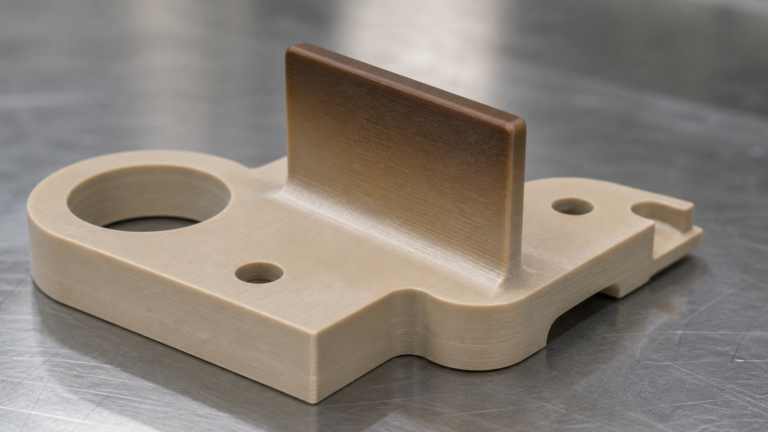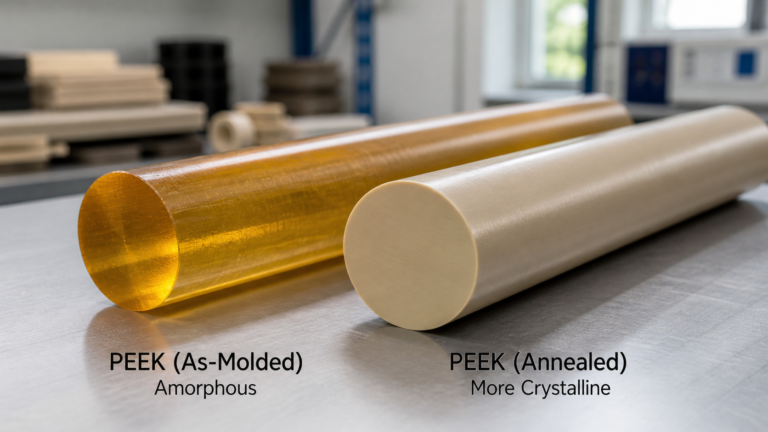
Should Every Injection-Molded PEEK Part Be Annealed?
Struggling with the decision to anneal your PEEK parts? This extra step adds cost and time, but is it always necessary for performance? Let's find out.
No, not every injection-molded PEEK part should be annealed. The decision must be evidence-based. We recommend you first assess if the as-molded part already meets application requirements. If not, use targeted testing on treated and untreated parts to justify the additional heat cycle.
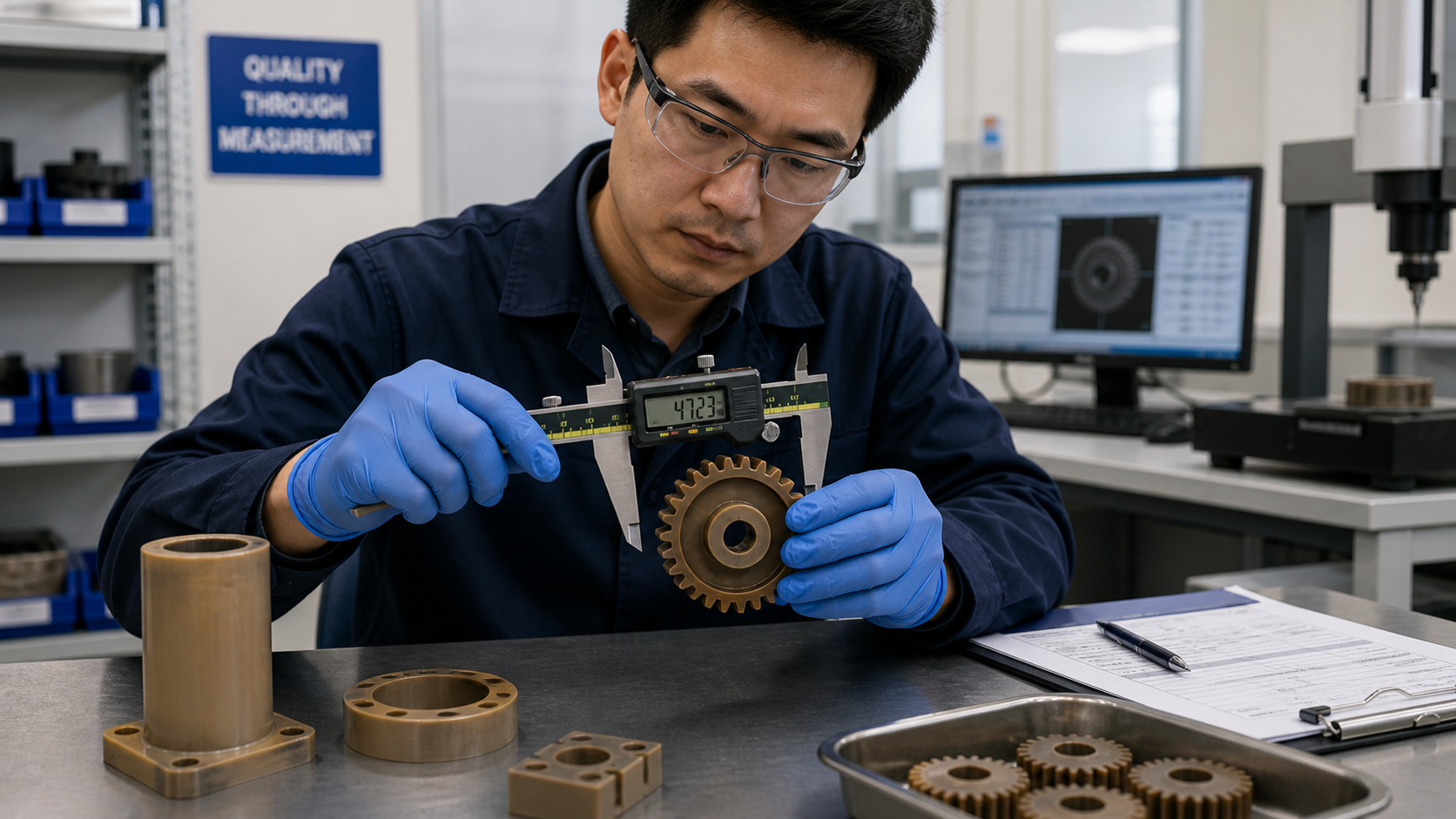
Annealing is a powerful tool in our toolbox for processing high-performance polymers like PEEK. It can enhance dimensional stability, stiffness, and chemical resistance by increasing the material's crystallinity. But I've seen many projects where annealing is treated as a mandatory checklist item rather than a deliberate engineering choice. This mindset can lead to unnecessary costs and, in some cases, can even degrade a property that is critical for the part's function, like toughness. The key is to move away from relying on the polymer's name alone and instead focus on what the specific application demands. Let's walk through a practical, evidence-based framework for deciding when—and when not—to add that extra heat cycle.
Assessing Whether the As-Molded Part Already Meets Requirements?
Are you adding an annealing step without first checking if it's needed? This common practice can waste both time and money on a solution for a non-existent problem.
First, you must test the as-molded part against its specific performance requirements. If its dimensional stability, mechanical properties, and other critical characteristics are already within the acceptable range for its intended environment, the part may not need annealing at all.
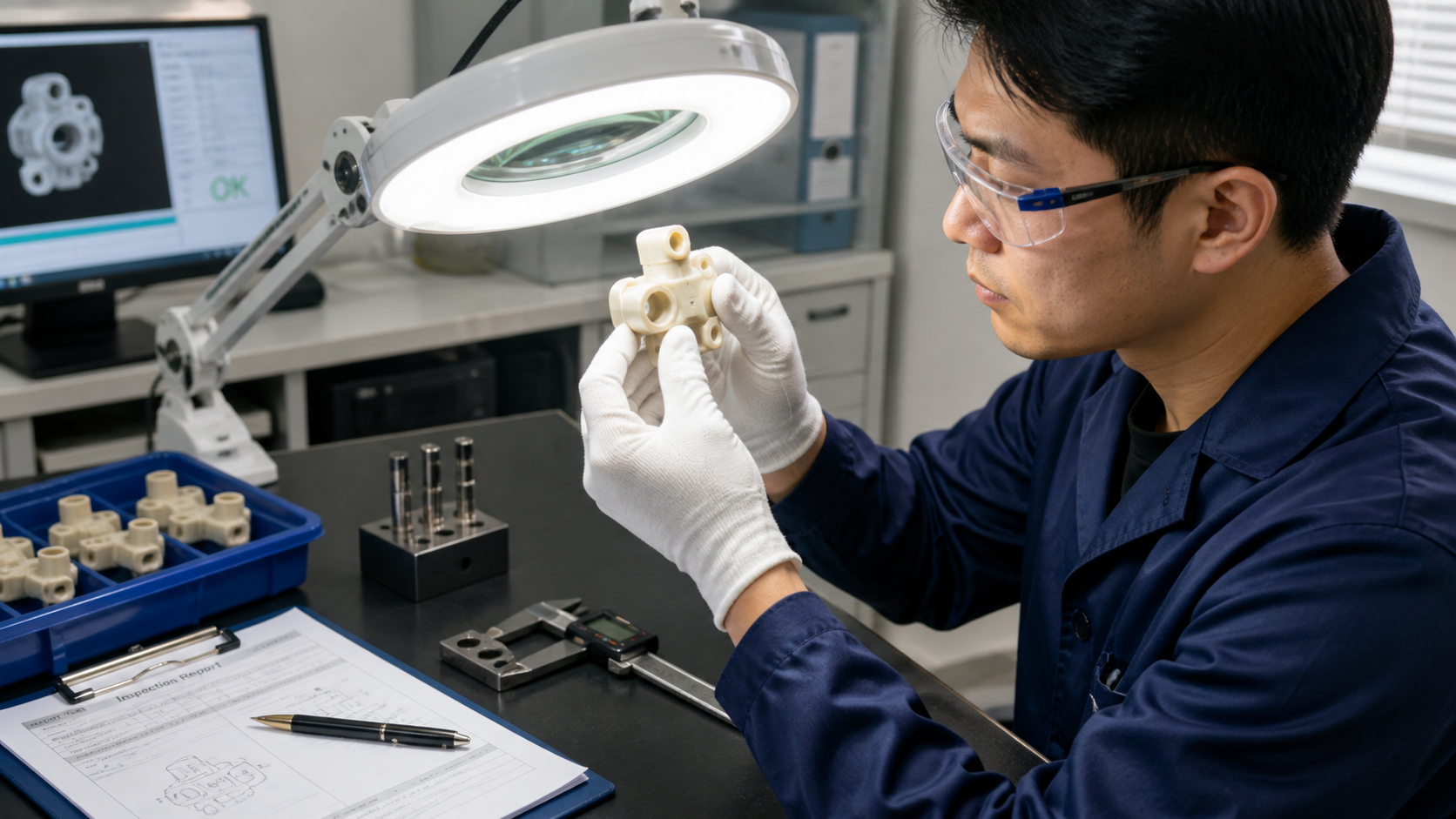
Before we even consider sending parts to an oven, our first job is to understand the baseline. Modern injection molding technology and tooling have advanced significantly. With precise control over mold temperature, injection speed, and cooling rates, it's possible to achieve a relatively high and uniform level of crystallinity directly out of the mold. The part you hold in your hand might already be perfectly suitable for its job. The only way to know for sure is to test it against the real-world demands it will face. This means we don't just guess; we measure.
Key Questions for As-Molded Parts
We start by asking a series of direct questions that connect the as-molded part's properties to the application's non-negotiable limits. This initial evaluation saves a tremendous amount of effort down the line. We use a simple table to organize our thoughts and make sure nothing is overlooked.
| Requirement Area | Guiding Question |
|---|---|
| Dimensional Stability | Do the part’s critical dimensions, as-molded, fall within the tolerance bands specified on the engineering drawing? |
| Thermal Performance | Will the part maintain its required shape and strength at the maximum continuous operating temperature it will experience? |
| Mechanical Load | Does the as-molded part have sufficient tensile strength, flexural modulus, and impact resistance to handle the loads in its service life? |
| Chemical Exposure | Is the as-molded part’s chemical resistance adequate for the fluids or gases it will encounter? |
If the answer to all relevant questions is "yes," then we have a strong case that annealing is an unnecessary step.
Selecting Properties That Annealing Is Intended to Change?
Do you apply annealing as a general fix-all? This approach can backfire, accidentally weakening a property that was perfectly fine, like impact strength or flexibility.
You must select the specific properties you want to improve with annealing. Common targets include maximizing crystallinity for better high-temperature dimensional stability, increasing stiffness (modulus), or enhancing resistance to aggressive chemicals. Know your goal before you start the process.
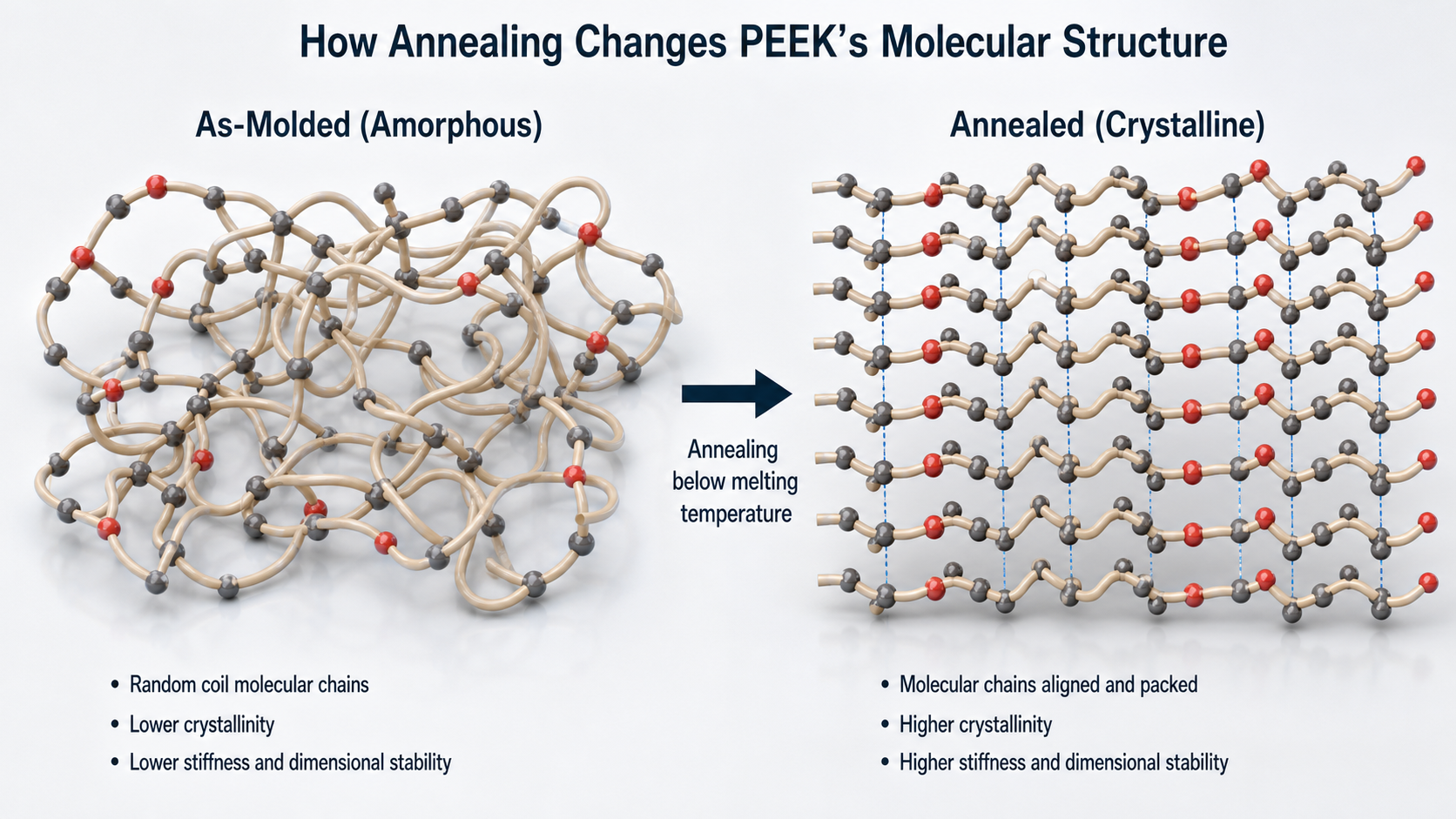
Annealing is not a magic wand; it's a targeted thermal treatment designed to change specific material characteristics. The process involves heating the PEEK part to a temperature below its melting point but above its glass transition temperature. Holding it there allows the polymer chains to relax and rearrange themselves into more orderly, crystalline structures. This increase in crystallinity is what drives the property changes. However, these changes come with trade-offs.
I recall a project involving a PEEK component with a critical snap-fit feature. The customer’s specification sheet demanded annealing simply because the material was PEEK. We knew from experience that while annealing would increase the part's stiffness and dimensional stability, it would also reduce its elongation at break, making it more brittle. A brittle snap-fit is a broken snap-fit. We had to push back and present data showing that the as-molded part had sufficient flexibility for the snap-fit to function repeatedly, while the annealed part would fail on the first or second use. By identifying the key property—flexibility—we were able to justify skipping the heat treatment and deliver a functional part. This highlights why you must have a clear "why" before you anneal.
Comparing Treated and Untreated Production-Representative Parts?
Are you making your decision based only on generic material data sheets? These sheets provide useful starting points, but they don't represent your unique part and process.
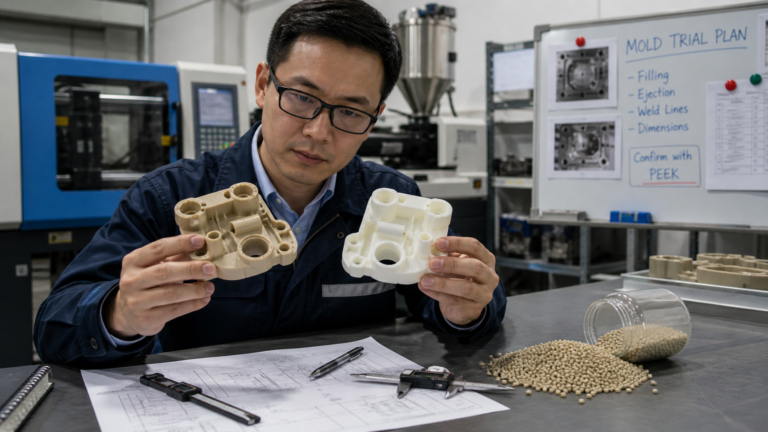
The most reliable method is to conduct a head-to-head comparison. Take a sample batch of parts molded with your production process, anneal half of them, and then test both the treated and untreated groups against your application's specific functional requirements.
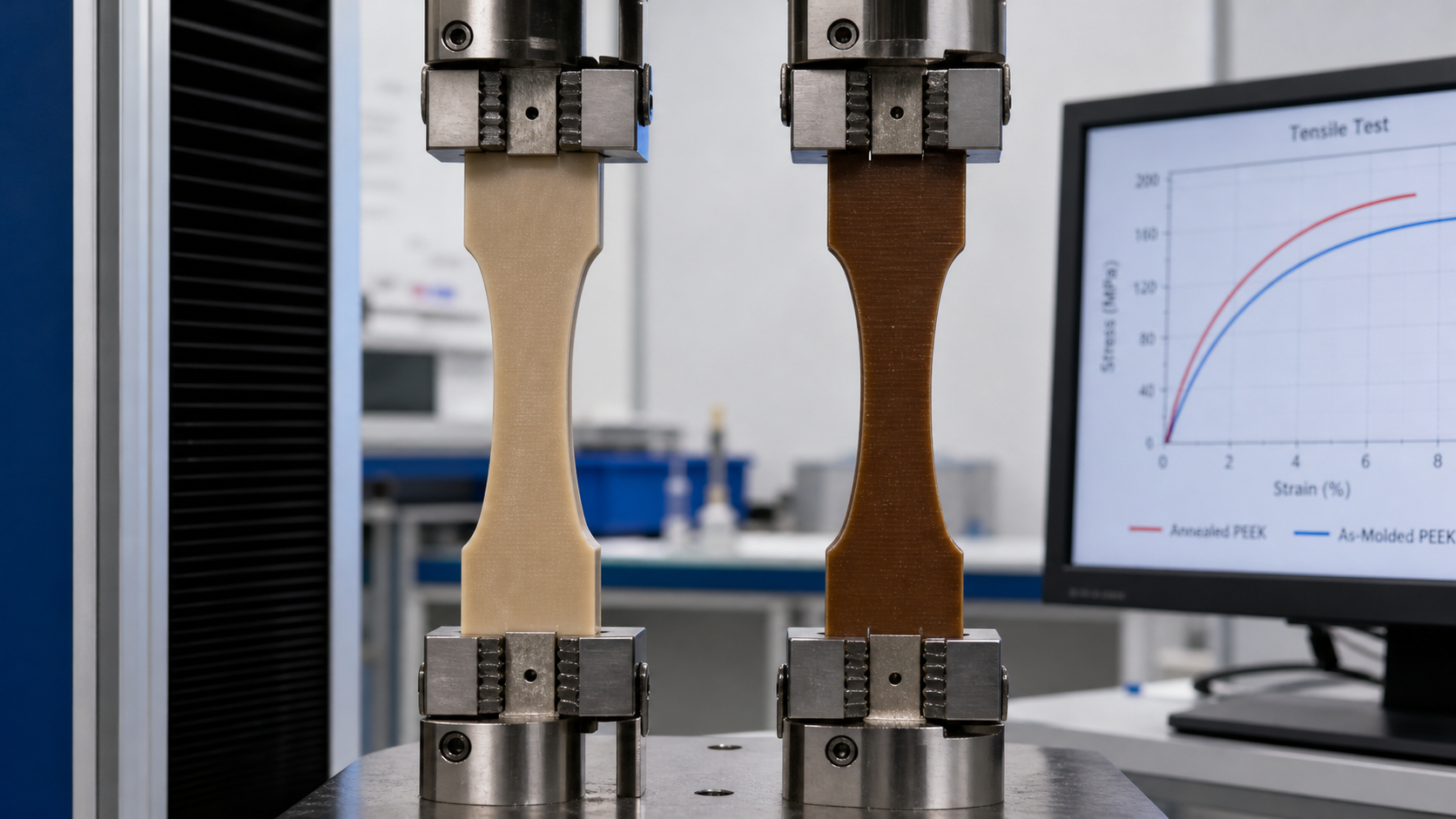
This is where theory meets reality. A material data sheet provides values obtained from standardized test specimens (like tensile bars) molded under ideal conditions. Your actual part has a different geometry, with varying wall thicknesses, gates, and weld lines that all influence its final properties. The only way to get data that truly matters is to test the parts you are actually going to use. We call these "production-representative" parts because they come from the same tool and process as the final production run.
This comparative testing approach removes all the guesswork. I once worked on a project for a fluid-handling component where high-temperature stability was the top priority. The as-molded parts seemed fine at room temperature, but we needed to be certain they wouldn't deform under pressure at 150°C.
A Practical Testing Framework
We followed a simple but effective plan:
- Define Criteria: We established that the part could not deform more than 0.5% in its critical dimension after 100 hours at 150°C under a specific load.
- Produce Samples: We molded a batch of 50 identical parts.
- Divide and Treat: We set aside 25 parts as the "as-molded" control group and annealed the other 25 using a carefully controlled thermal cycle.
- Test Both Groups: We subjected parts from both groups to the exact same high-temperature load test.
- Analyze Evidence: The results were clear. The as-molded parts showed an average deformation of 1.2%, failing our criteria. The annealed parts showed only 0.3% deformation, passing with a comfortable margin. This evidence made the decision to anneal easy and justifiable.
When the Evidence Does Not Justify Another Heat Cycle?
Do you ever find that the data shows minimal benefit from annealing? Pushing ahead with the process anyway adds unnecessary cost, complexity, and lead time to your project.
You should not anneal when the as-molded parts already meet all performance specifications. It's also not justified when the negative trade-offs, such as a significant reduction in toughness or impact strength, create a new failure mode for a different requirement.
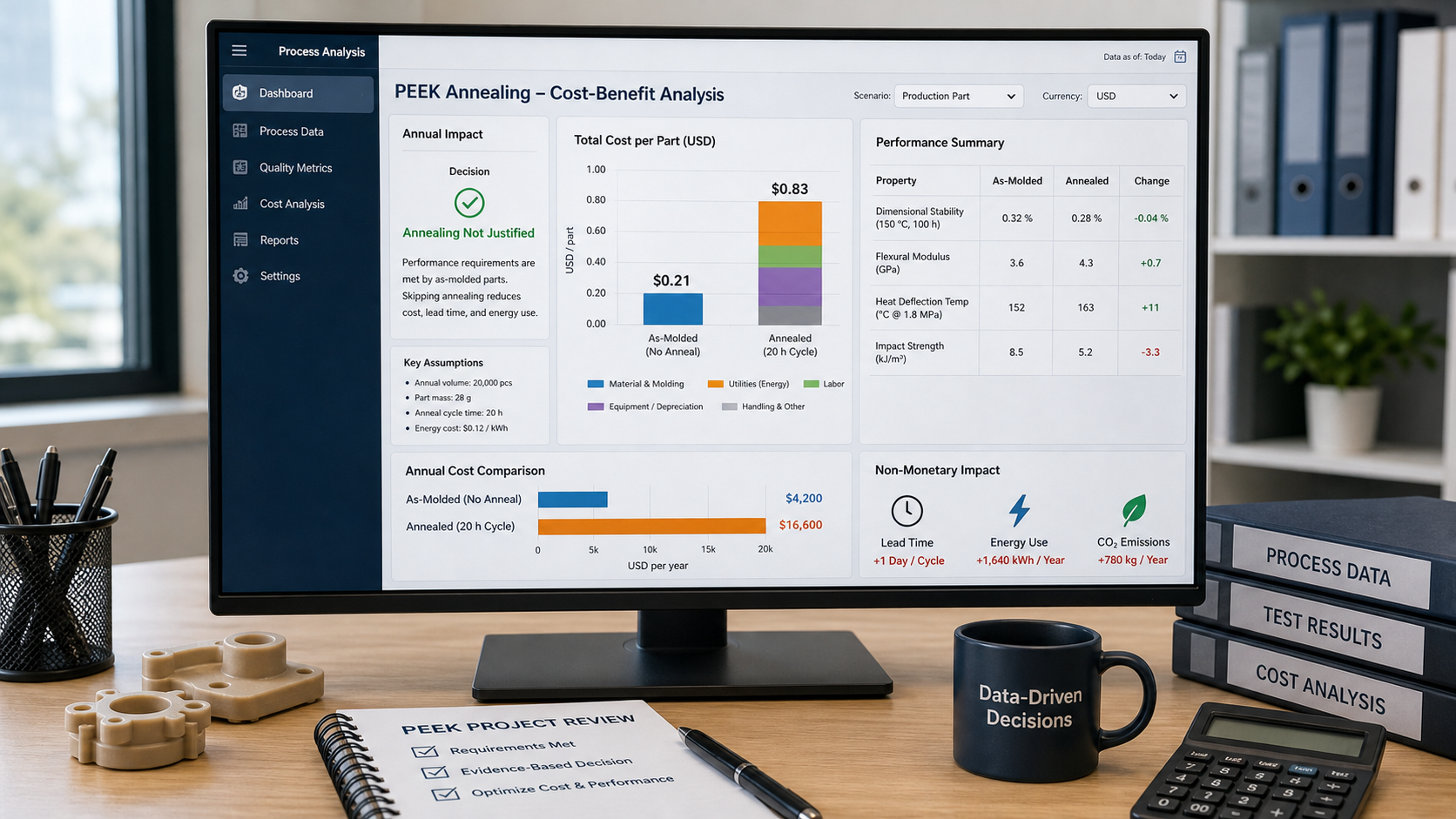
Making an evidence-based decision also means knowing when to stop. If your comparative tests show that the as-molded parts perform just as well as the annealed ones for your specific application, then the decision is simple: don't add the extra step. The evidence does not support the added cost, energy consumption, and production time. This is not a failure; it is a success in process optimization. It means your molding process is well-controlled and capable of producing parts that are fit for purpose right out of the tool.
There are also clear scenarios where the evidence actively points away from annealing. As we discussed with the snap-fit example, any application that relies on the inherent flexibility or toughness of PEEK is a poor candidate for annealing. The increase in stiffness and brittleness that comes with higher crystallinity would be detrimental. Another case is when a component is designed to absorb impact energy. Annealing reduces PEEK's ability to yield and absorb that energy, making it more prone to fracture. In these situations, the "improvement" in one property comes at too high a cost to another, more critical one. The decision must always be balanced against the complete set of application requirements.
Conclusion
Ultimately, annealing PEEK is a strategic choice, not a default step. An evidence-based approach, centered on testing your actual parts against real-world needs, will always lead to the right decision.
My Role
About me
Brand Name: VantPoly
Slogan: Engineering Polymer Materials and Custom Components
Website: https://vantpoly.com
Company Overview
VantPoly supports industrial buyers with high-performance engineering polymer materials, semi-finished products, and custom-manufactured components for demanding applications. Our work covers material supply, grade and form selection, profile processing, CNC machining, inspection, documentation, packaging, and international order coordination.
We focus on practical requirements such as operating temperature, chemical and moisture exposure, mechanical load, wear, electrical performance, dimensional stability, cleanliness, certification needs, production quantity, and total project cost. We support projects from initial material screening and prototypes to repeat production. Product claims, test values, compliance documents, and material suitability must always be confirmed for the exact grade, batch, process, and intended application.
Our Core Business
1. High-Performance Polymer Materials
We supply high-performance engineering polymers including PEEK, PEI, PPS, PPSU, PSU, PI, and PAI in selected standard, reinforced, conductive, wear-resistant, colored, and application-specific grades. Available forms may include granules, powders, films, sheets, rods, tubes, and other semi-finished products. Availability of a specific polymer, formulation, grade, size, color, or certification must be confirmed before it is presented as an offer.
2. Compounding & Application-Specific Grades
We support reinforced and modified formulations for requirements involving stiffness, wear, friction, electrical insulation, conductivity, static dissipation, flame performance, dimensional stability, color, and processing behavior. Material recommendations must be based on the complete service environment and validated against the supplier's technical data, customer specifications, and appropriate testing.
3. Semi-Finished Shapes & Profile Processing
We provide sheets, rods, tubes, films, cut-to-size stock, and selected extruded profiles for machining and further processing. Product form, extrusion history, annealing condition, dimensions, tolerances, surface requirements, and internal stress can affect downstream machining and part performance, so these factors should be addressed when relevant to the article.
4. Custom Components & Manufacturing Support
We support drawing-based CNC machining, cutting, profile extrusion, prototyping, small-batch production, and repeat manufacturing for engineering polymer components. Projects are reviewed according to the material grade, geometry, tolerance, surface requirement, working environment, quantity, inspection scope, documentation, and shipping needs. Injection molding, molding trials, or other processes should be described only when they are relevant to the topic and confirmed for the project.
Product Applications & Technology Focus
Primary Service Industries:
Our principal customer sectors include Semiconductor Equipment, Medical and Laboratory Equipment, Aerospace, Automotive and E-Mobility, Electrical and Electronics, Oil and Gas, Chemical Processing, Food-Processing Equipment, Fluid Handling, Scientific Instruments, and Industrial Machinery.
Product Categories We Serve:
- High-Performance Polymer Granules and Powders
- Reinforced, Conductive, Wear-Resistant, and Colored Grades
- Engineering Plastic Sheets, Rods, Tubes, Films, and Profiles
- Cut-to-Size and Machine-Ready Stock Shapes
- CNC-Machined Precision Polymer Components
- Prototype, Replacement, and Small-Batch Parts
- Drawing-Based Custom Components
- Material, Grade, and Product-Form Selection Support
Technology Expertise:
Our documented technical focus includes:
Material Selection, Polymer Compounding, Reinforcement and Modification, Profile Extrusion, Cutting, CNC Machining, Annealing and Stress Control, Dimensional Inspection, Surface Inspection, Batch Traceability, Processing Review, and Application-Based Technical Support.
Production Capacity & Equipment
Polymer Processing & Semi-Finished Product Platform
Our documented capabilities include material pelletizing, continuous profile extrusion, cutting, controlled production, and the supply of granules, sheets, rods, tubes, films, profiles, and other semi-finished products. We support standard and selected customized sizes, grades, formulations, colors, and reinforced options according to project requirements.
- Product Platform Highlights: PEEK, PEI, PPS, PPSU, PSU, PI, and PAI materials; virgin and reinforced grades; powders and granules; sheets, rods, tubes, films, and profiles; and cut-to-size stock for further processing.
Precision Machining & Inspection Platform
We support CNC machining and drawing-based production for prototypes, replacement parts, small batches, and repeat orders. Documented capabilities include multi-axis machining, dimensional inspection, surface inspection, material and batch records, final inspection, and export packaging.
- Equipment and Process Highlights: 4-axis and 5-axis CNC machining, continuous profile extrusion, pelletizing, automatic cutting, controlled workshop conditions, dimensional measurement, surface-roughness inspection, and agreed material-property testing where applicable.
Engineering Polymer & Component Capabilities
General Capabilities:
- Application and operating-condition review
- Material family, grade, reinforcement, and product-form selection
- Granule, powder, sheet, rod, tube, film, and profile supply
- Reinforced, conductive, wear-resistant, colored, and application-specific formulations
- Profile extrusion, cutting, annealing, and stress-control coordination
- CNC machining from drawings, CAD files, physical samples, or specifications
- Prototype, engineering-validation, replacement-part, and small-batch support
- Dimensional, appearance, surface, and agreed property inspection
- Batch traceability and applicable technical-document support
- Protective packaging, export documents, and international shipment coordination
Our Core Specialties:
- ✔️ High-Performance Polymer Selection based on temperature, chemicals, load, wear, electrical needs, tolerances, and documentation
- ✔️ PEEK, PEI, PPS, PPSU, PSU, PI, and PAI materials in multiple forms and selected grades
- ✔️ Precision CNC-Machined Components produced from drawings, samples, and application requirements
- ✔️ Materials-to-Finished-Parts Support covering sourcing, processing, inspection, packaging, and export coordination
Quality Control & Certifications
We apply project-specific inspection and documentation requirements to incoming materials, production, finished components, and shipment preparation. The exact inspection scope depends on the material, grade, product form, drawing, application, order specifications, and agreed acceptance criteria.
Quality Management Scope:
Our documented quality activities include checking incoming resin and semi-finished products, recording material grades and production batches, verifying applicable dimensions and tolerances, inspecting appearance and surface condition, reviewing quantity and packaging, and maintaining supporting records for repeat orders. The blog must not claim that VantPoly performed a test, supplied a named customer, achieved a specific tolerance, or holds a particular certification unless that fact is present in the article input or confirmed company information.
Testing & Inspection Focus:
- Material identity, grade, formulation, and supporting-document review
- Dimensions, tolerances, geometry, and fit according to agreed drawings
- Appearance, surface condition, and surface roughness where specified
- Selected mechanical, thermal, electrical, wear, or other properties where agreed
- Processing history, annealing condition, and internal-stress considerations where relevant
- Batch traceability, quantity, labeling, packaging, and export-protection checks
Certifications & Compliance:
- ISO 9001 quality-management documentation where applicable
- RoHS and REACH documentation for applicable grades
- SGS or other independent test reports where available
- FDA-related, NSF-related, food-contact, medical, or other compliance documents only for applicable grades
- Material certificates, technical data sheets, inspection reports, and batch records as agreed
Certification and document availability varies by polymer family, manufacturer, grade, formulation, batch, destination market, processing method, and intended application. Never generalize one grade's certificate or test result to an entire polymer family. Confirm the exact supporting documents before making a formal compliance claim.
Target Markets & Partnership Models
Who We Serve:
- Materials Engineers & Product Designers: Teams comparing polymer families, grades, reinforcements, and product forms against real operating conditions
- Injection Molders & Process Engineers: Professionals working with high-temperature materials, drying, tooling, melt stability, crystallinity, ejection, warpage, and repeatable processing
- Machining Companies & Component Manufacturers: Shops requiring stable stock shapes, machining guidance, controlled stress, tolerances, surface quality, and repeatable material supply
- Semiconductor & Electronics Manufacturers: Engineering and procurement teams requiring dimensional stability, insulation, clean handling, chemical resistance, ESD control, or high-frequency performance
- Medical & Laboratory Equipment Companies: Teams evaluating sterilization resistance, chemical compatibility, dimensional stability, traceability, and applicable documentation
- Aerospace, Automotive & E-Mobility Companies: Engineers seeking lightweight, heat-resistant, electrically functional, wear-resistant, or chemically resistant components
- Oil, Gas, Chemical & Fluid-Handling Companies: Buyers requiring seals, valve seats, rings, pump parts, and other components for corrosive, high-pressure, wear, or elevated-temperature service
- Industrial Distributors & Global Buyers: Importers, distributors, procurement teams, and equipment manufacturers sourcing materials, stock shapes, custom parts, and international delivery support
Target Geographies:
We serve international B2B customers and coordinate export packaging, commercial documents, shipment requirements, and technical communication according to the destination and order. Product availability, regulatory documents, customs requirements, shipping method, and delivery schedule must be confirmed for each project.
Types of Cooperation:
- Material Supply: Standard, reinforced, modified, colored, conductive, and application-specific polymer grades
- Semi-Finished Product Supply: Sheets, rods, tubes, films, profiles, powders, granules, and cut-to-size stock
- Material Selection Support: Initial screening based on temperature, chemicals, load, wear, electrical needs, tolerances, documentation, process, and budget
- Custom Manufacturing: Drawing-based cutting, extrusion, CNC machining, prototypes, replacement parts, small batches, and repeat production
- Inspection & Documentation: Agreed dimensional, appearance, surface, material, batch, and supporting-document checks
- International Order Support: Quotation review, protective packaging, commercial documents, shipment coordination, and technical communication
Our Core Competitive Advantages
⭐ Integrated Material and Component Supply
By coordinating engineering polymer materials, semi-finished shapes, extrusion, cutting, CNC machining, inspection, and export support, we help buyers manage material and component requirements through one supply workflow.
⭐ Application-Based Material Selection
We review operating temperature, chemical exposure, mechanical load, friction and wear, electrical performance, dimensional tolerances, cleanliness, documentation, production quantity, and budget before recommending a material family or grade.
⭐ Flexible Product Forms & Customization
Our documented offering covers granules, powders, sheets, rods, tubes, films, profiles, cut-to-size stock, reinforced or modified formulations, selected colors, and custom-machined parts according to project needs.
⭐ Prototype-to-Repeat-Production Support
We support prototypes, engineering validation, replacement parts, low-volume orders, and repeat production based on drawings, samples, material specifications, and agreed inspection requirements.
⭐ Traceability, Inspection & Global Coordination
Material grades, batches, applicable records, dimensions, appearance, packaging, and shipment requirements can be coordinated to reduce sourcing risk and support consistency across international orders.