Why Do Thin PEEK Features Develop Darker Surface Regions?
You received your PEEK parts, but the thin-walled sections look darker, almost burnt. Your first instinct is to reject them, worrying about material degradation and performance failure.
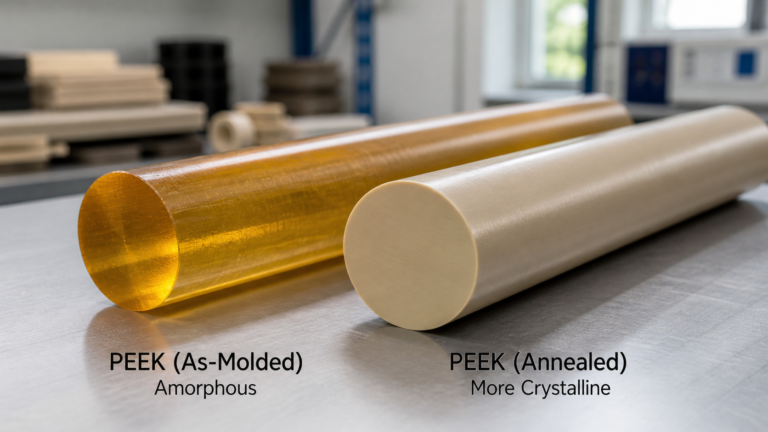
Thin PEEK features develop darker surfaces because they cool much faster than thicker sections. This rapid cooling, or quenching, freezes the polymer chains on the surface in a disordered, amorphous state. This amorphous "skin" is more translucent and appears darker than the highly crystalline, light-tan PEEK core.
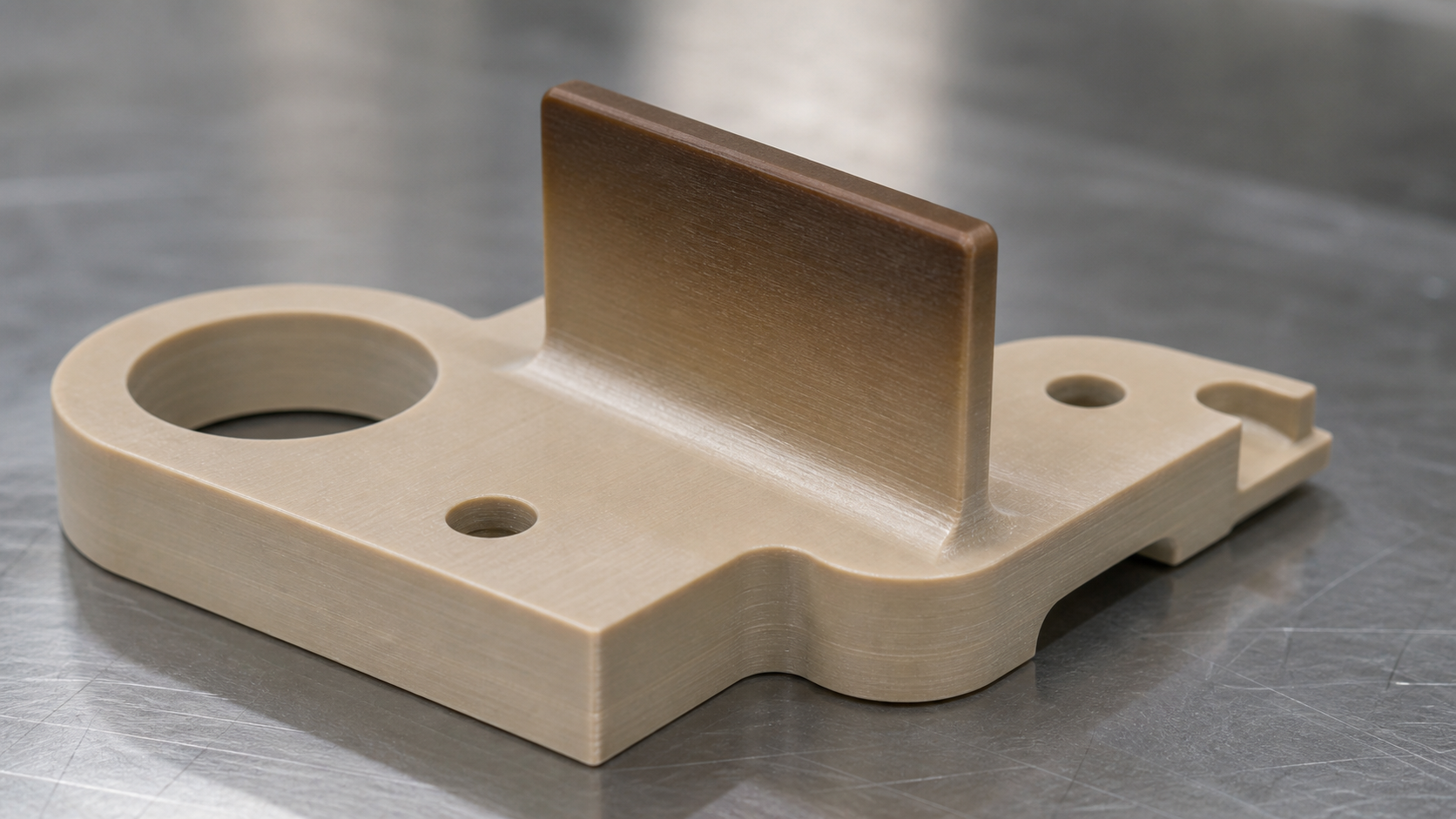
This color difference can be alarming if you're not expecting it. It makes you question whether the part is still good or if the material has been damaged during processing. But before we jump to conclusions based on appearance, we need to understand what’s happening beneath the surface. The answer lies in how heat escapes from different part geometries. Let’s look at why a thin wall and a thick block of the same PEEK material cool at very different rates and what that means for the final part.
Comparing Heat Removal in Thin and Thick Features?
You see a single PEEK component with both light tan and dark brown areas. This inconsistency makes you question the quality of the entire part. Is one section weaker than another?
Thin features have a high surface-area-to-volume ratio, which lets heat escape very quickly. Thick features hold onto heat much longer. This difference in cooling rate is the primary driver of PEEK’s final crystalline structure and, as a result, its surface color.
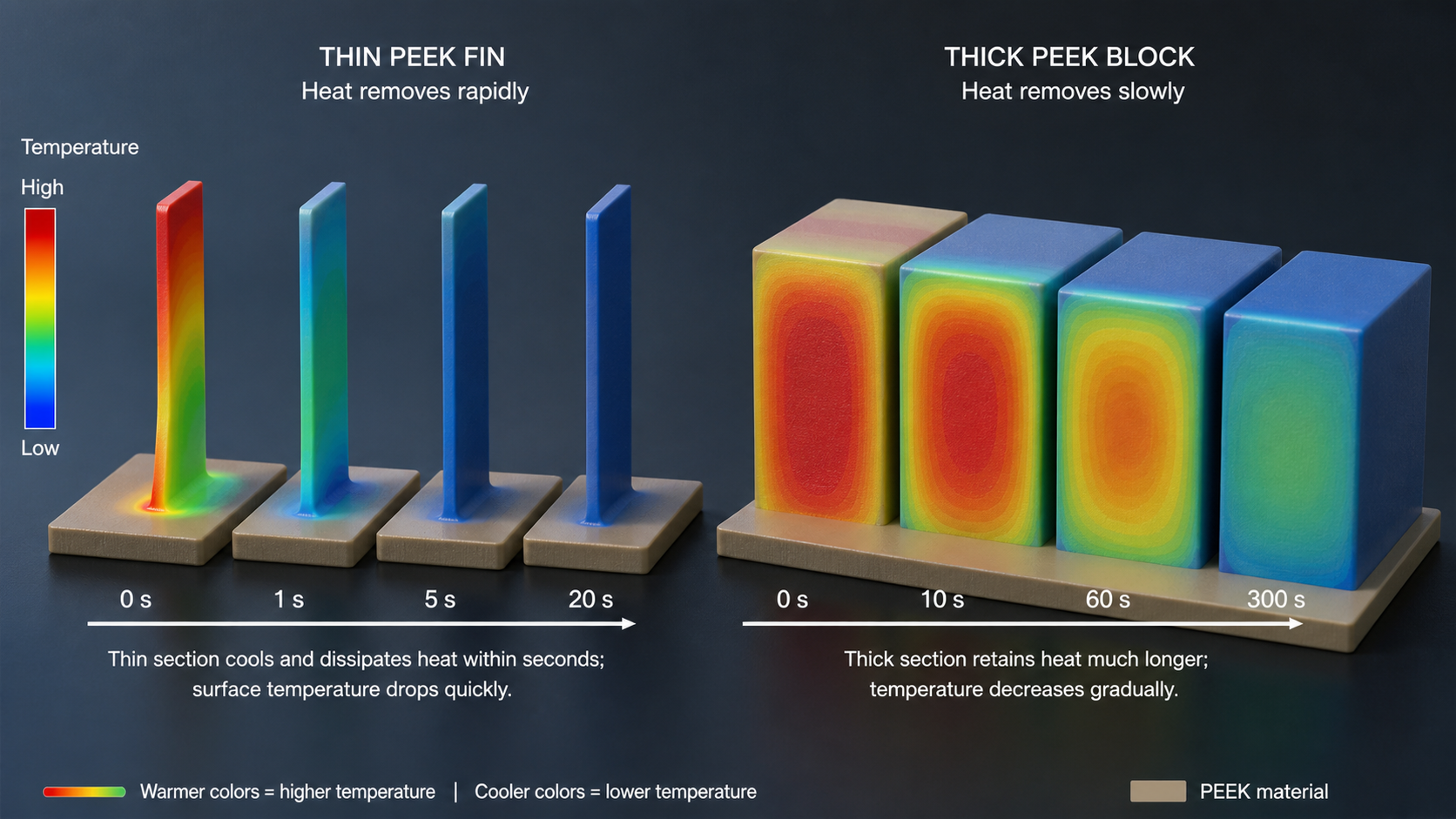
When we talk about heat removal, the geometry of the part is everything. PEEK is a semi-crystalline polymer, which means its final structure depends heavily on its thermal history. The slower it cools from its melt temperature, the more time the polymer chains have to organize themselves into dense, ordered crystalline structures. This highly crystalline state is what gives PEEK its characteristic opaque, light-tan color.
Cooling Rate vs. Crystallinity
In a thin feature like a fin or a narrow rib, the situation is completely different. It has a lot of surface area compared to its small internal volume. As soon as the heat source (like a cutting tool or a hot mold) is removed, heat radiates away from the surface almost instantly. This rapid cooling "quenches" the surface, locking the polymer chains in place before they have a chance to organize. This disordered, or amorphous, state is less dense, more translucent, and appears darker.
We can summarize the relationship in a simple table.
| Feature Characteristic | Thin Section | Thick Section |
|---|---|---|
| Surface-Area-to-Volume Ratio | High | Low |
| Cooling Rate | Fast (Quenched) | Slow (Annealed) |
| Resulting Crystallinity | Lower (Amorphous Skin) | Higher (Crystalline Core) |
| Visual Appearance | Darker, More Translucent | Lighter Tan, Opaque |
This is why you can see two different colors on the same part. It’s not a material defect; it’s a predictable outcome of the physics of heat transfer in complex geometries.
Examining the Skin Beneath a Dark Surface Region?
The dark surface on a thin PEEK feature looks like a critical defect. You feel you have no choice but to scrap the part and start over, losing time and money.
When we look just beneath the dark surface, we almost always find the expected light-tan, crystalline PEEK. The discoloration is a very thin amorphous "skin" formed by rapid cooling. The core of the feature, even if it's thin, is often properly crystalline and performs as expected.
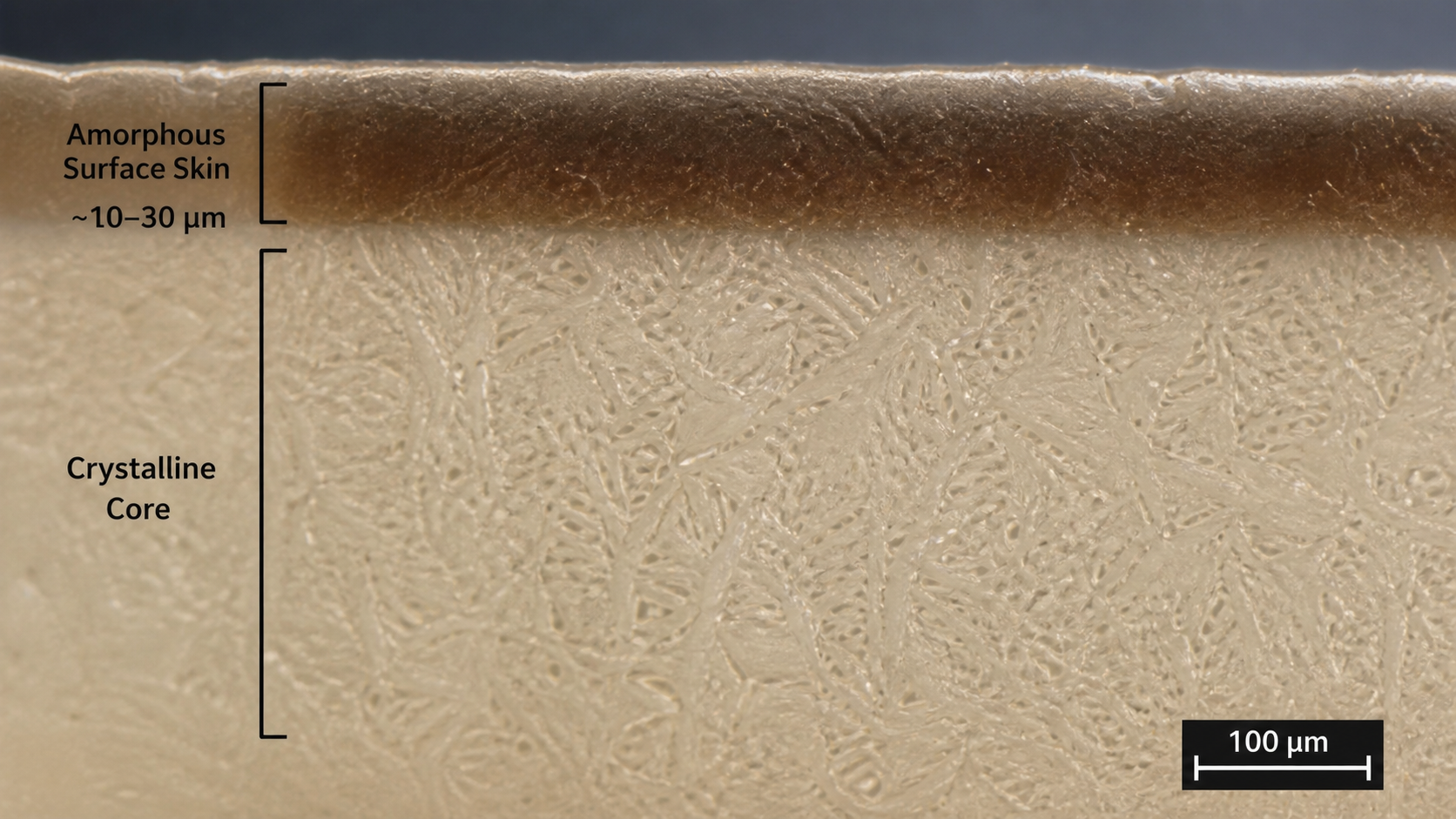
This phenomenon is known as the "skin-core effect" in polymer science. The surface (the skin) experiences the most rapid temperature change, while the inside (the core) is insulated and cools more slowly. This effect is present in almost all semi-crystalline polymers processed from a melt state, including those machined from semi-finished stock shapes. During machining, the cutting tool introduces significant heat right at the surface. That heat dissipates very quickly into the air or coolant, especially on a thin feature, creating the amorphous skin.
I remember working on a project that involved a set of very small PEEK insulator pins. When we received them from the machine shop, they were a dark, almost chocolate-brown color, nothing like the typical tan PEEK. The customer was immediately concerned about degradation. We agreed to sacrifice one pin for analysis. We carefully cut it open and polished the cross-section. Just a few hundredths of a millimeter beneath the surface, the material was the perfect light-tan color. The dark skin was incredibly thin but was enough to change the entire appearance of the part. Seeing that evidence gave the customer the confidence to approve the batch.
Selecting Cross-Sections That Capture Local Variation?
You need to prove that a PEEK component is acceptable despite its inconsistent color. Just cutting it randomly in half might not provide the clear evidence you need to make your case.
To effectively capture local variation, you should select cross-sections at locations where the part’s thickness changes abruptly. A cut that goes from a thick base to a thin wall provides a direct, side-by-side comparison of the skin-core structure in both areas.
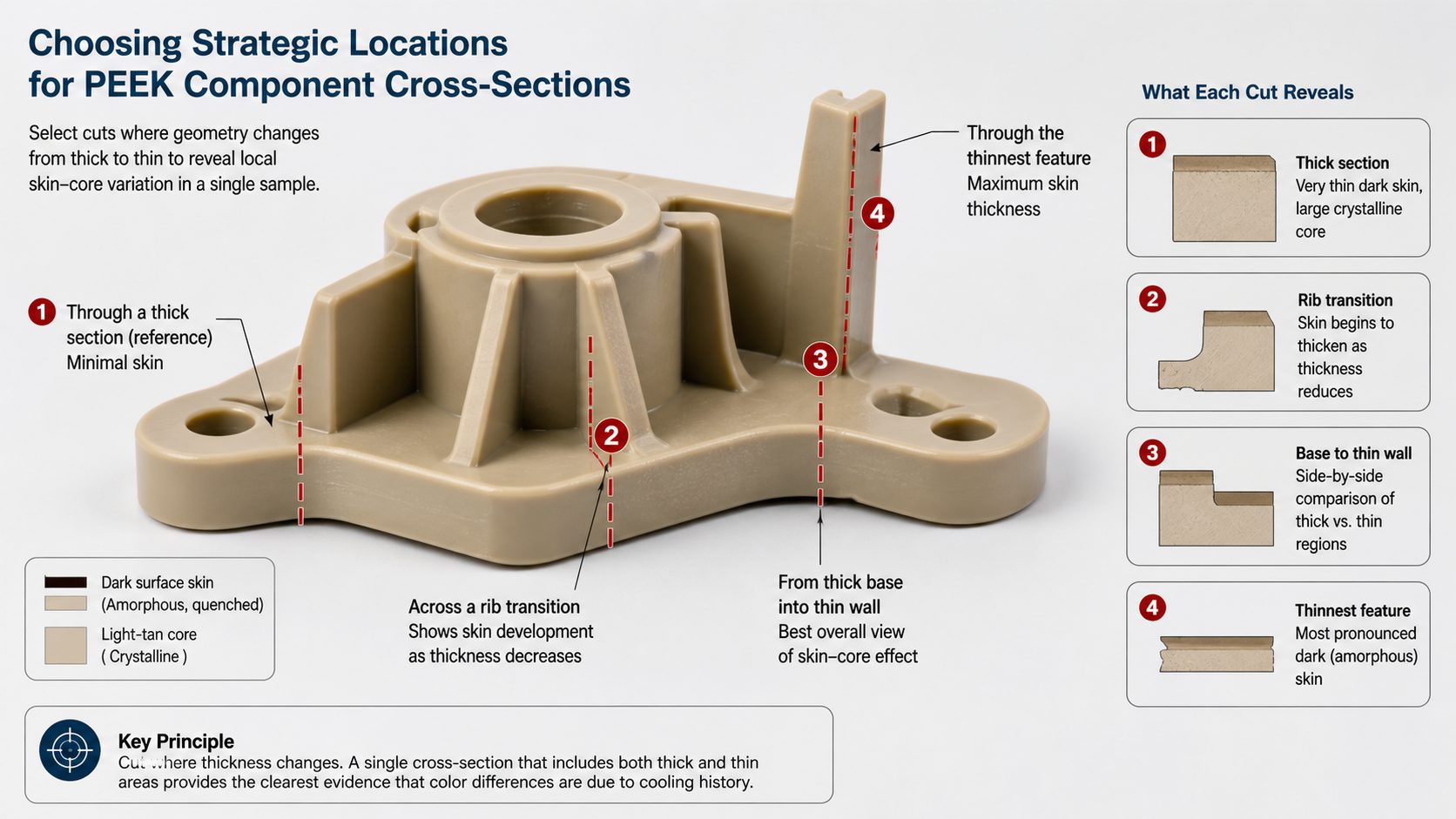
A well-chosen cross-section tells a clear story. It’s the best way to turn a subjective discussion about color into an objective, evidence-based conversation about material structure. The goal is to create a sample that visually confirms the link between geometry, cooling rate, and the resulting skin-core effect.
When a client raises a concern about color, we suggest a methodical approach. First, we identify the thinnest feature on the part, as this is where the dark, amorphous skin will be most prominent. Next, we find a spot where that thin feature joins a much thicker section of the part. This transition zone is the perfect place to make a cut. By sectioning the part here, we get a single sample that shows everything. On one side, you have the thick section with its minimal, almost invisible skin and a large crystalline core. On the other, you see the thin section with its more noticeable dark skin.
This visual evidence is powerful. It demonstrates that the underlying bulk material is consistent across the entire part. The only difference is the thin surface layer, whose presence is directly explained by the part's geometry. This helps everyone on the team understand that they are not looking at a material defect, but at a predictable outcome of the manufacturing process.
Validating the Feature's Properties Before Rejecting by Colour?
A PEEK part meets all dimensional specifications, but its dark color makes you hesitate. Rejecting it feels wrong, but accepting it feels risky. What should you do?
Instead of rejecting a part based on color, validate the properties that are critical for its final application. Check the dimensions, test a sample for mechanical strength, or perform a functional fit test. Color is a very poor indicator of PEEK's engineering performance.
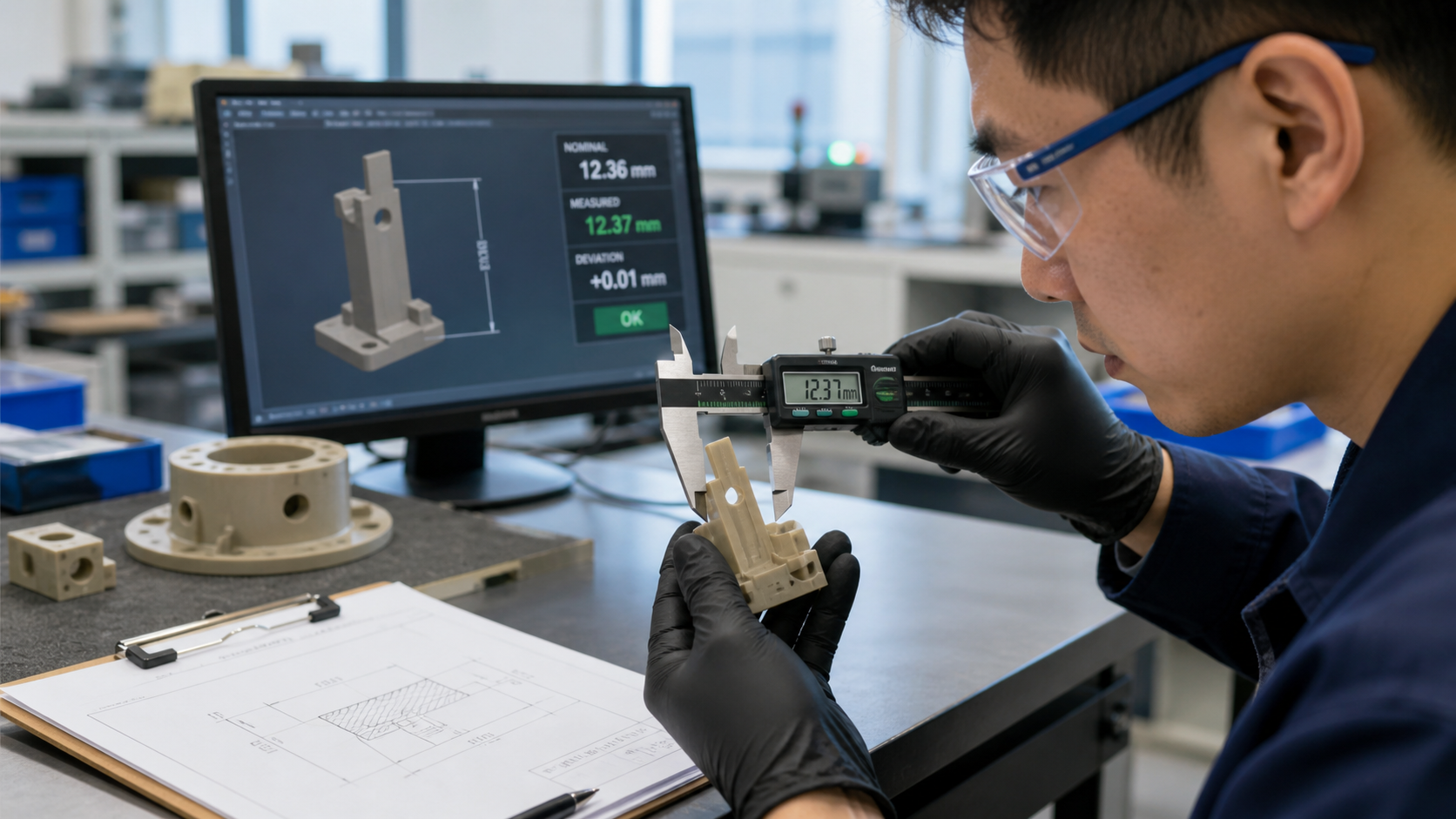
Appearance can be misleading. In engineering, performance is what matters. A part that looks different isn't necessarily a bad part. The most important question is: does the part meet the functional requirements defined in the drawing and specification? We always advise our partners to focus on evidence-based validation rather than subjective visual inspection.
The first and most critical check is always dimensional accuracy. Is the part within tolerance? If the dimensions are correct, it has already passed a major hurdle. For most applications in industries like semiconductor or medical equipment, holding tight tolerances is far more important than achieving a uniform color.
Second, consider the mechanical requirements. Is the feature subject to high stress or impact? While an amorphous skin can be slightly less hard than a crystalline core, it can also be more ductile and less brittle. In some cases, it might not negatively affect performance at all. If mechanical strength is a major concern, it should be validated with tests that reflect the real-world application, not judged by sight. We must always rely on the original material supplier's data sheet for the grade's certified properties. The goal is to confirm the part works for the specific application, not to make it look identical to a standardized test coupon.
Conclusion
Dark surfaces on thin PEEK features are usually a result of rapid cooling, not material defects. Understand the cooling history, inspect cross-sections, and validate functional properties before rejecting a part on color.