Why Do Plastic Clamps Lose Force Without Breaking?
Your plastic clamp was tight, but now it's loose. This failure seems mysterious because the part isn't cracked or broken. Understanding why is key to reliable design.
Plastic clamps lose force due to a material property called stress relaxation. Under a constant bend (strain), the polymer chains inside the plastic slowly rearrange over time, especially when warm. This reduces the internal stress, which is the source of the clamping force, without causing breakage.
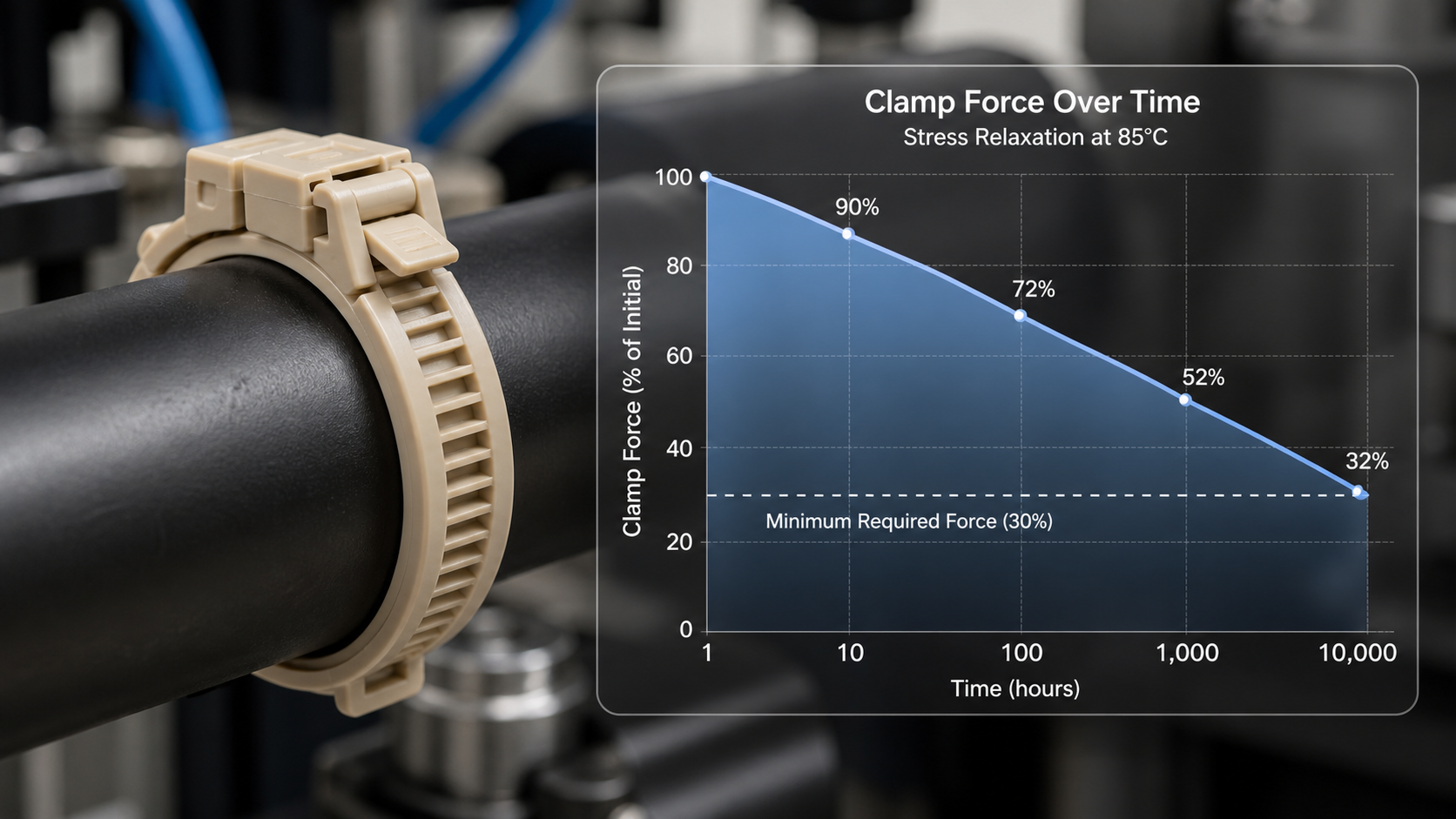
I've seen this happen many times in projects. A component works perfectly in initial testing, but after a few months in service, it fails. The customer is confused because there's no visible damage. The clamp just isn't clamping anymore. This quiet, gradual failure is often more dangerous than a sudden break because it can go unnoticed until a leak or a disconnection occurs. The root cause isn't a defect in the part; it's a fundamental behavior of the polymer material itself. To prevent this, we have to look beyond the initial strength of the material and consider how it behaves over its entire service life. Let's dig into the mechanics of this phenomenon.
Distinguishing Fixed Displacement From Fixed Load?
Engineers sometimes use the terms creep and stress relaxation interchangeably. This confusion can lead to selecting the wrong material for an application. We need to be clear about the difference.
Fixed displacement involves holding a part in a fixed shape, like a bent clamp. The resulting internal force decreases over time; this is stress relaxation. Fixed load involves applying a constant weight, which causes the part to deform more over time; this is creep.
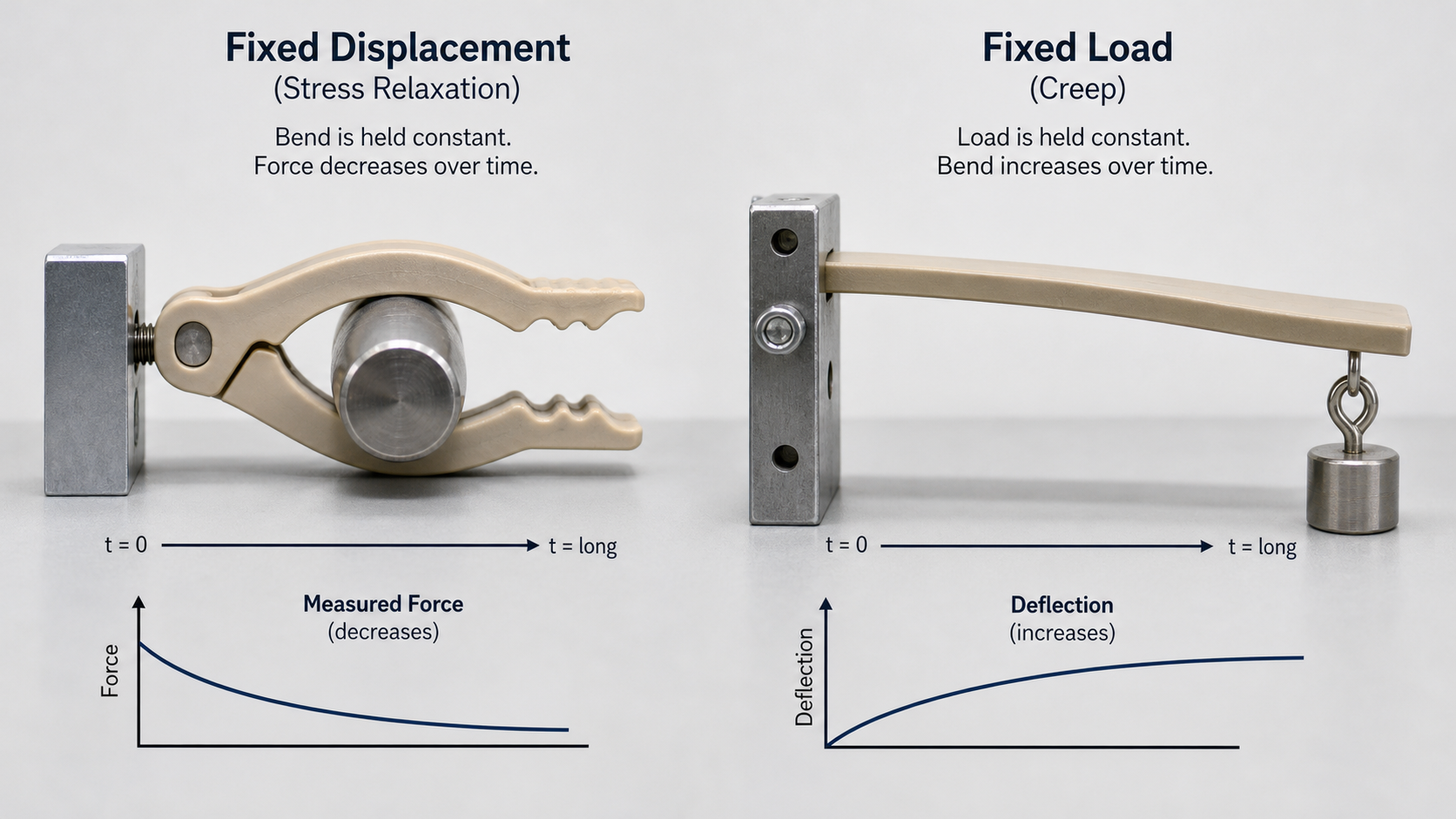
When we design a clamp, we are working with a fixed displacement scenario. You tighten the clamp, bending its arms to a specific position, and then you leave it. The geometry is constrained. The initial force it exerts is high, but as the polymer chains settle into a more relaxed state, that force drops. It's like holding a yoga pose; your muscles are under constant strain, and over time, the effort it takes to hold the pose feels like it lessens as your body adapts. In contrast, creep is what happens if you hang a heavy coat on a plastic hook. The load (the coat's weight) is constant. Over time, you might notice the hook has started to sag and deform permanently. Both are time-dependent behaviors, but they describe different responses to different types of constraints.
The Two Types of Material Deformation
Understanding which phenomenon applies to your component is the first step in predicting its long-term performance. A clamp that loses force or a shelf that sags are both failures, but their causes are different.
| Feature | Fixed Displacement (Stress Relaxation) | Fixed Load (Creep) |
|---|---|---|
| What is Held Constant? | The shape or strain (e.g., how much it’s bent). | The force or stress (e.g., a constant weight). |
| What Changes Over Time? | The internal force decreases. | The shape or strain increases. |
| Common Application Example | Clamps, seals, press-fit inserts, snap-fits. | Shelving, hooks, parts supporting a constant weight. |
Tracking Clamp Force While Geometry Remains Constrained?
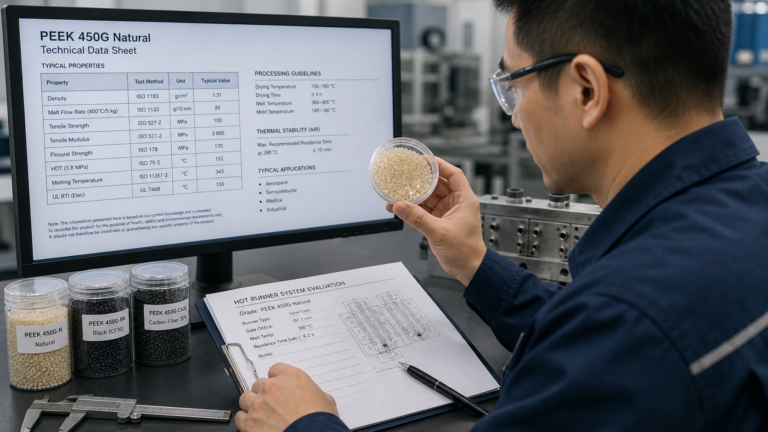
Relying on a polymer's name alone is not enough. You might think "PEEK is strong," but that doesn't tell you how it will perform long-term. This guesswork is risky. The solution is to use real test data.
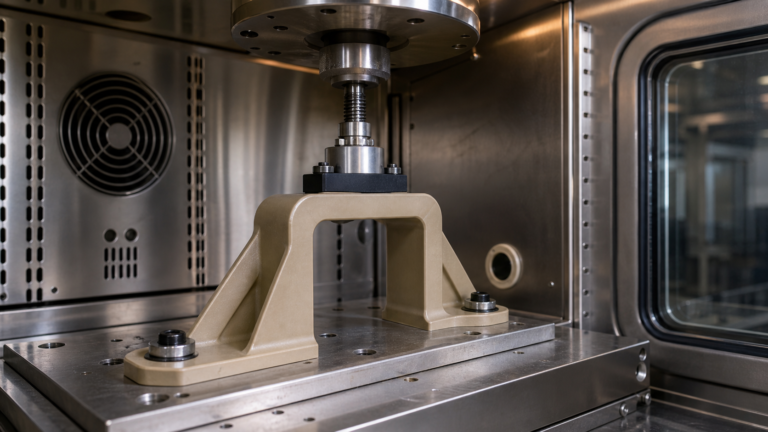
We track clamp force by installing the plastic part in a special fixture with an integrated load cell. The clamp is tightened to a set displacement, and the load cell continuously measures the force it exerts over weeks or months, creating a data curve of force retention.
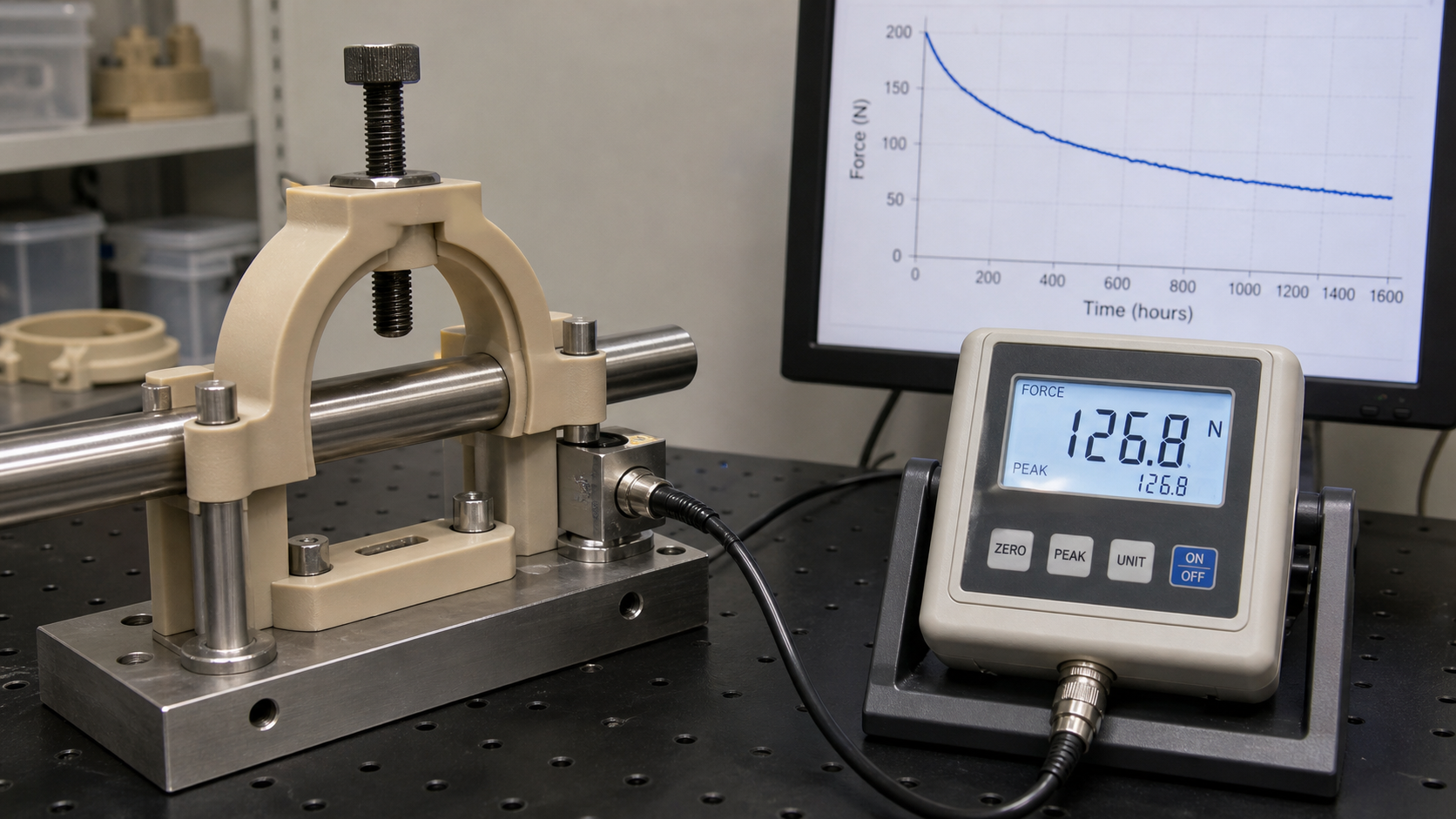
This kind of testing provides the hard evidence we need to make informed design decisions. When we work with material suppliers, we look for this specific data. We don't just ask for a generic technical data sheet. We ask for long-term stress relaxation curves, preferably at the customer's specific operating temperature. This data allows us to compare different materials an an apples-to-apples basis. For example, a standard PPS might lose 50% of its force in 1,000 hours at 150°C, while a glass-reinforced grade might only lose 25%. Without this test data, you would be designing in the dark. As a supplier of custom components, our role is to help clients find and correctly interpret this information. We retain the original supplier's test conditions and application limits to ensure the data is used responsibly and not presented as our own evidence. This makes the design process an evidence-based decision, not a gamble.
Checking Temperature's Effect on Retention?
You might have a clamp that holds perfectly at room temperature. But in the application, it's next to an engine and gets hot, then suddenly fails. This is a common and dangerous problem.
Heat gives polymer chains more energy, allowing them to move and untangle faster. This greatly accelerates stress relaxation, causing a clamp to lose its retention force much more quickly than at cooler temperatures. Performance must be verified at the application's true operating temperature.
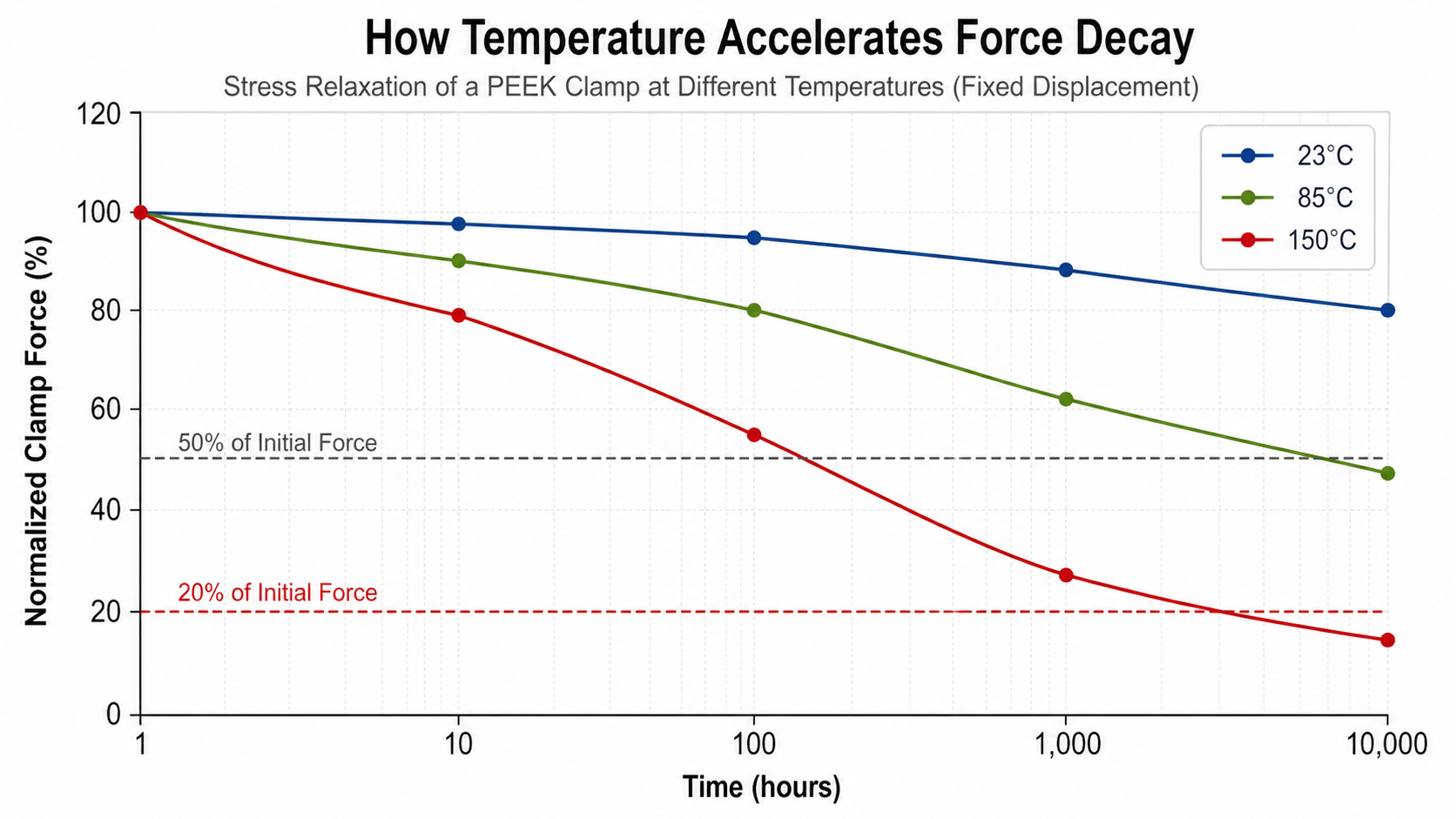
I always tell my clients that temperature is the great accelerator. A material that seems rock-solid at 23°C (73°F) can behave like soft taffy at 150°C (302°F). The data sheet might list a high heat deflection temperature (HDT), but that number only tells you the temperature at which a specific bar deflects a specific amount under a specific load. It says nothing about long-term force retention. The critical factor is how the material behaves over time at a constant temperature. For high-performance polymers like PEI or PAI, their ability to resist stress relaxation at high temperatures is what makes them valuable. When we help a customer select a material for a demanding application in the semiconductor or aerospace industry, we always start with the operating temperature. Then we look for the stress relaxation data at that temperature to ensure the part will continue to perform its function for its entire intended life.
Designing for the Force Needed at End of Life?
Many designers focus on the initial force a clamp generates. They calculate it, test it, and approve the design. But this is a mistake, as the force will not stay that high.
To design correctly, you must first define the minimum force required for the part to function. Then, using stress relaxation data for your chosen material and temperature, you calculate the initial force needed to ensure it stays above that minimum threshold throughout its entire service life.
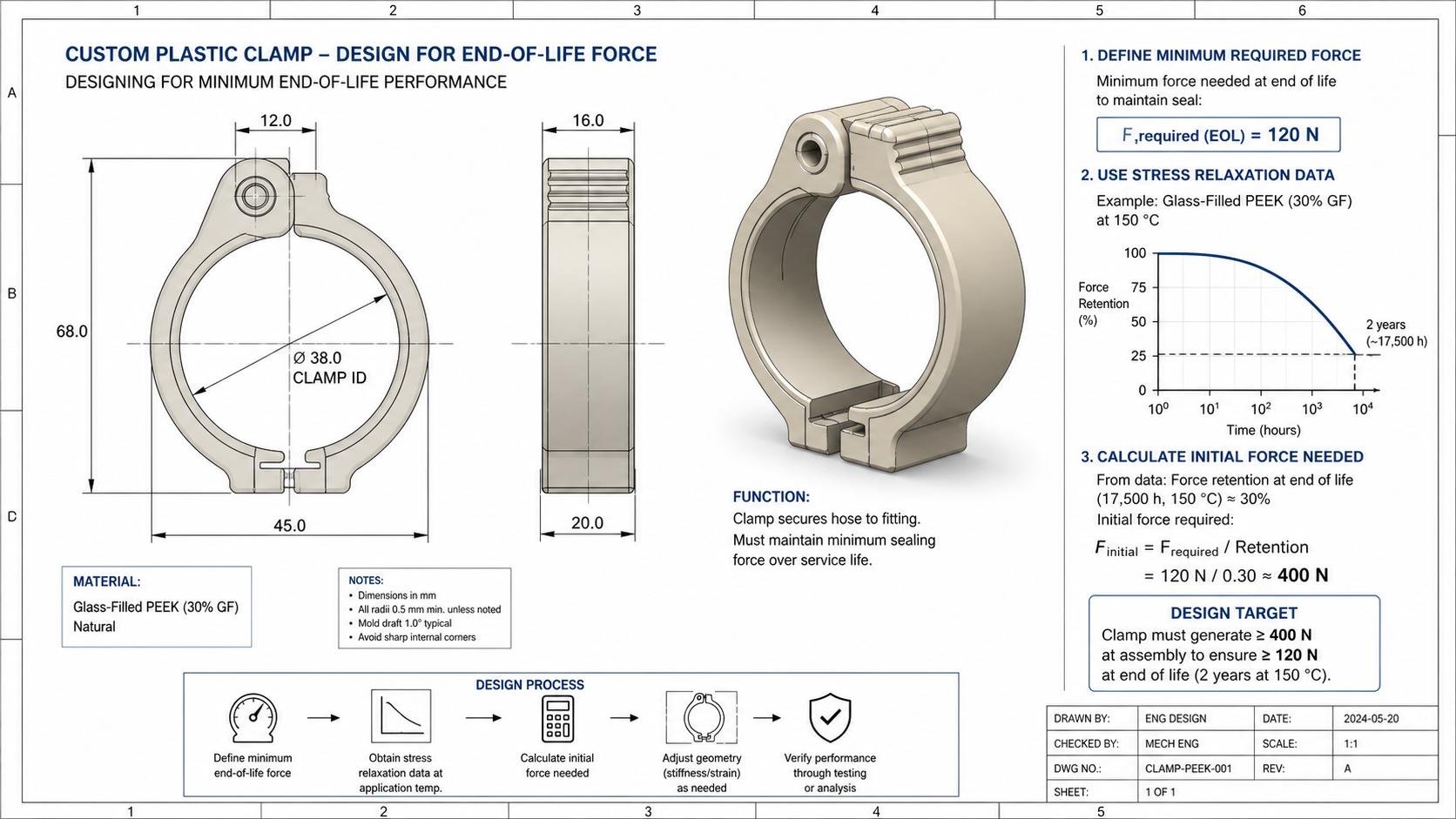
This is a complete shift in thinking. We are not designing for Day 1; we are designing for Day 1,000, or whatever the required service life is. I remember a project involving a fluid handling component where a leak could have been catastrophic. The team initially chose a material based on its chemical resistance and initial strength. But when we projected the force retention over two years at the system's operating temperature, we found it would drop below the minimum sealing pressure required. The solution wasn't just a different material. We had to work on the component's geometry, making the clamping section thicker to increase the initial strain and stored energy. This provided a higher starting force, so even after the expected relaxation, the final force remained safely above the required minimum. This is the core of application-based material selection. It’s a process that combines understanding the application's needs, using supplier data, and sometimes modifying the component design to ensure long-term, reliable performance.
Conclusion
Plastic clamps lose force from stress relaxation, not from breaking. Designing with the end-of-life force in mind, using real data for time and temperature, ensures long-term component reliability.