
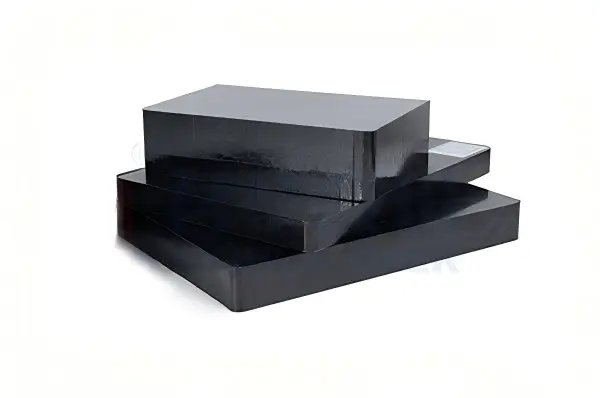
Black Polyimide (PI) | 300°C High-Performance Stock & Parts
Extreme Environment Reliability: -269°C to +300°C.
We are a specialized manufacturer of high-purity Black Polyimide, offering Sheets, Rods, Tubes, Powder, and Pellets. Whether you require raw machining stock or complex CNC-finished components, we provide technical consulting, competitive lead times, and strict Non-Disclosure Agreement (NDA) protection for your proprietary engineering.
Product information
Published information supports preliminary product selection. Confirm the exact grade, dimensions, tolerances, documentation and application suitability with the quotation for your order.
Description
I. Unrivaled Performance Specifications
-
Thermal Stability: Retains critical mechanical properties at continuous 300°C (572°F); short-term thermal excursions up to 480°C.
-
UHV & Plasma Compatibility: Ultra-low outgassing (Total Mass Loss TML <1.0%) for Ultra-High Vacuum (10⁻¹⁰ Torr) and aggressive plasma etching environments.
-
Self-Lubricating Tribology: Graphite/PTFE-filled black grades offer a low coefficient of friction (0.05 – 0.25) and exceptional wear resistance in non-lubricated high-load duties.
-
Mechanical Precision: High flexural modulus and compressive strength; stress-relieved to ensure zero warping during micron-level CNC machining.
-
Radiation & Chemical Resistance: Stable under high-energy radiation (10⁹ rads) and immune to most fuels, solvents, and industrial acids.
II. Comprehensive Grade Selection
-
PI-G15 (Graphite-filled): Standard black grade for general-purpose bearings, seals, and thrust washers.
-
PI-G40 (High-load): Enhanced graphite content for extreme wear resistance in dry-running applications.
-
PI-P (Bearing/Friction): Proprietary blends for maximum PV (Pressure-Velocity) limits in high-speed rotary seals.
-
Raw Forms: High-purity PI Powder for compression molding; PI Pellets for injection/extrusion processing.
III. Full Spectrum Supply & Customization
-
Stock Shapes:
-
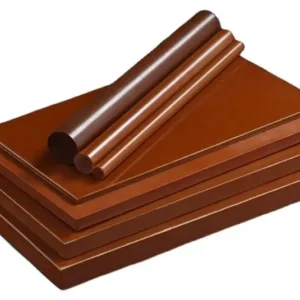
Sheets: Thickness 5mm to 100mm; Surface flatness <0.2mm.
-
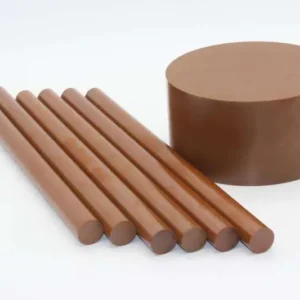
Rods: Diameter Ø6mm to Ø150mm; High straightness for Swiss-style machining.
-
Hollow Tubes: Custom OD/ID to maximize material yield and reduce cost.
-
-
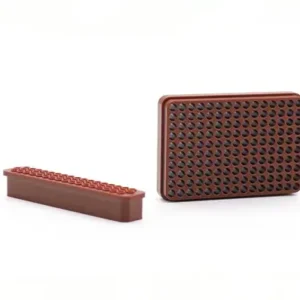
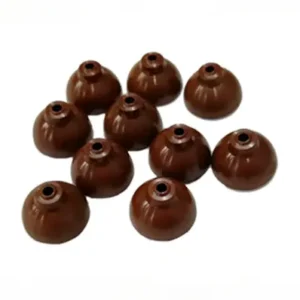
Finished Component Machining: Our in-house facility produces finished parts (gears, bushings, insulators) from your 2D/3D CAD files, ensuring Vespel® SP-21 / SP-22 / SP-3 equivalent performance.
-
Technical Support: In-depth grade selection assistance based on your specific temperature, load, and chemical environment.
IV. Strategic Industry Applications
-
Semiconductor: Wafer handling vacuum pads, plasma-chamber insulators, and high-purity test socket housings.
-
Aerospace & Defense: Jet engine seal rings, cryogenic valve seats, and high-temp electrical connectors.
-
Glass Manufacturing: Hot-end handling pads and take-out inserts that prevent thermal shock and scratching.
-
Nuclear & Scientific: Components for particle accelerators and radiation-shielding structural parts.
V. Quality Assurance & Confidentiality
-
IP Protection: We operate under strict NDA (Non-Disclosure Agreement) protocols. Your proprietary drawings and designs are 100% secure.
-
Documentation: Full batch traceability with TDS (Technical Data Sheet), COA (Certificate of Analysis), and RoHS/REACH compliance.
-
Lead-Time Advantage: Direct factory supply allows us to beat the lead times of major brands (Vespel®, Meldin®) by several weeks.
Material overview
Understanding PI (Polyimide)
Why engineers use it
- Strong thermal stability for electrical and mechanical applications.
- Excellent insulation potential in films and precision parts.
- Low wear and low outgassing options in selected grades.
- Good dimensional control in carefully processed components.
- Available in forms suited to insulation, machining or formulation work.
Limits to consider
- “PI” is a family name, not a single universal grade.
- Moisture, processing route and fillers affect dimensions and performance.
- Some forms cannot be melt processed like ordinary thermoplastics.
- High cost requires a clearly defined performance need.
- Acceptance values must be tied to the exact product and test method.
Grades and product forms
Film grades target flexible insulation; powder and resin support formulation or molding routes; stock shapes serve machined components; graphite, PTFE or other fillers may tune wear and friction. Product form and grade must be identified explicitly in the RFQ.
Performance points to review
| Evaluation area | Why it matters | Information to provide |
|---|---|---|
| Temperature behavior | Useful performance under elevated or changing temperature | Continuous and peak temperature, cycle length and time at load |
| Mechanical response | Strength and stiffness must match the real part geometry | Load direction, stress level, impact and fatigue expectations |
| Environmental resistance | Fluids, cleaning agents and atmosphere can change service life | Chemical name, concentration, temperature and exposure time |
| Dimensional control | Tight-tolerance parts depend on both material and processing | Finished dimensions, tolerances and assembly conditions |
| Electrical or insulation needs | Electrical requirements may influence grade and thickness | Voltage, dielectric, conductivity or insulation target |
These are engineering discussion points, not guaranteed property values. Final acceptance criteria should be agreed for the selected grade, process and order.
Typical application directions
These examples show where the material may be evaluated. They do not replace a suitability review for the finished component.
Fabrication and processing preparation
Provide thickness, width, length, flatness and tolerance requirements plus the finished drawing if the sheet will be machined. Machining allowance and residual-stress considerations should be included for tight-tolerance parts.
Where the application is critical, define what a successful trial looks like before material is ordered: dimensions after processing, visual condition, mechanical response, assembly fit or another measurable result.
When another material may be better
PBI and PAI can address different extremes of heat, strength and wear, while PEEK may offer easier processing for some applications. PI is selected when its thermal, electrical or tribological balance solves the specific design problem.
We recommend sharing the current material and the reason it is being reconsidered. Cost, processability, supply form and inspection burden belong in the decision alongside technical performance.
Information needed for an accurate quotation
A useful RFQ reduces follow-up questions and helps us distinguish between a material request and a finished-part requirement.
| Product form | Raw material, stock shape, semi-finished blank or completed part |
|---|---|
| Dimensions | Nominal size, finished size and tolerances |
| Quantity | Trial quantity, first order and estimated annual demand |
| Application | Part function and current material, if any |
| Operating temperature | Continuous range, peak temperature and cycle duration |
| Environment | Chemicals, gases, moisture, pressure, vacuum or outdoor exposure |
| Mechanical duty | Load, speed, impact, wear and mating components |
| Documentation | Drawing revision, inspection, traceability or compliance needs |
Frequently asked questions
Can I request a sample or trial quantity?
Trial quantities can be discussed according to product form and availability. Tell us what you need to prove during the trial, the intended process and the expected production quantity if the test succeeds.
Do you provide a data sheet or material documentation?
Available documentation depends on the selected material and supply route. List the documents required by engineering, purchasing or quality when you inquire so they can be checked before quotation.
Can the grade be selected from a product name alone?
No. Similar product names can cover different grades, colors, fillers and processes. Selection should be based on the finished application, environment and required property balance.
Can you supply custom dimensions or finished parts?
Custom sizes, blanks or finished parts can be reviewed where appropriate. A drawing with tolerances, quantity and material requirement is the best basis for quotation.
How should we evaluate an alternative to our current material?
Share the current grade, the part’s service conditions and the reason for changing it. A useful comparison looks at failure mode, processing, life, inspection and total project cost—not only a single property value.
What determines lead time?
Lead time depends on product form, grade, size, quantity, documentation, machining and current availability. Confirm the required delivery date and destination with the RFQ rather than assuming a standard schedule.
Send the drawing, application and quantity. We will use the project details to prepare a practical material and supply discussion.
Reviews
There are no reviews yet.